If you grew up watching Happy Days, you probably remember the leather jacket, the jukebox, the drive-in, and that unmistakable “Ayyyy!” from Fonzie.
For millions of viewers, the show became more than just another sitcom — it was a warm, nostalgic trip back to an idealized version of 1950s America.
But behind those familiar characters and unforgettable moments was a fascinating story filled with surprises.
The series almost looked completely different, one of its biggest stars struggled with something audiences never knew about, and a future comedy legend got his major break thanks to the show.
It almost wasn’t a 1950s show
When Garry Marshall was first asked to develop a sitcom in the early 1970s, the original idea was to set it during the 1920s or ’30s.
Marshall admitted he didn’t know enough about the flapper era, but he knew exactly which period he did understand: the 1950s.
He created a pilot about a Midwestern family getting its first television set, with their teenage son hoping the new gadget would help him attract girls. The pilot didn’t become a series and was eventually shown as a segment on Love, American Style.
Then everything changed.
The show almost had a very different name
Marshall initially wanted to call the series COOL. Test audiences, however, associated the word with cigarettes. Producer Carl Kleinschmitt eventually suggested Happy Days — a name that turned out to be a perfect fit.
Ron Howard had another reason for taking the role
Ron Howard wasn’t immediately sold on returning to television for Happy Days. After spending years in front of the camera, he worried about being stuck playing a teenager forever.
He initially turned down the role of Richie Cunningham, but Garry Marshall managed to change his mind with one important promise: if the show became a series, Richie and his friends wouldn’t stay teenagers forever. They would graduate, grow up and move into adulthood. Even Fonzie would eventually return to school to finish his education.

There was another reason the timing mattered for Howard, too. He had enrolled at USC with hopes of becoming a director, but his low military draft number was hanging over him.
Fortunately, his job with Paramount offered a possible occupational deferment because the company employed enough people who could potentially be affected if he were drafted.
So Howard accepted the role.
He probably couldn’t have known it at the time, but saying yes to Richie Cunningham would become one of the most important decisions of his career.
Fonzie almost looked very different
Henry Winkler wasn’t exactly what Garry Marshall had pictured when he imagined Fonzie.
Marshall had envisioned someone more physically imposing — the kind of guy who looked like Sylvester Stallone or Perry King. Winkler, who was shorter and didn’t have that classic tough-guy build, wasn’t the obvious choice.
In fact, he wasn’t even the only surprising contender. Former Monkees drummer Micky Dolenz was also considered for Arthur Fonzarelli, and Marshall initially liked him for the role. But at six feet tall, Dolenz was significantly taller than Ron Howard, making Winkler a better fit for the cast.
Then Winkler walked into the audition — and something clicked.
He may not have had the exact look Marshall imagined, but he absolutely nailed Fonzie’s attitude. Ironically, Winkler was channeling Stallone himself during the audition, having previously worked with him on The Lords of Flatbush.
Marshall realized that the attitude mattered more than the muscles.
And the rest, as they say, is television history: the world got Fonzie.
The Fonz became so popular that after the first few seasons, the network wanted to rename the show “Fonzie’s Happy Days” or just “Fonzie.”
Henry Winkler’s secret struggle
One of the show’s most beloved stars had spent much of his childhood struggling in school. Winkler wasn’t diagnosed with dyslexia until he was 31.
When he auditioned for Happy Days, he only had six lines — and because he couldn’t properly read them, he improvised.
When producers pointed out that his performance wasn’t exactly what was written, Winkler reportedly explained that he was giving them the essence of the character and would perform it exactly if he got the role.
He did.
When Fonzie went to the library
Speaking of reading struggles, Happy Days once tried to use Fonzie’s popularity for something a little more meaningful.
After the show became a huge hit, Garry Marshall was asked whether the series could do anything to encourage children to read. The answer came in a memorable episode where Fonzie — hardly the character you’d expect to find hanging around a library — decides to check out a book.
The moment ended with the simple message: “Everybody is allowed to read.”
A story later began circulating that the episode had an incredible impact, supposedly causing library card registrations to jump by 500 percent.
It sounds like the perfect feel-good Happy Days story — except there was one problem.
The American Library Association later found no evidence that library interest actually increased by anything close to that amount. So while Fonzie may not have caused a library-card revolution, he did deliver one pretty great message: reading was cool, too
Did you know this about the opening song?
Bill Haley & His Comets’ “Rock Around the Clock” became inseparable from the Happy Days experience.
But the original recording was only used for the show’s first episode.
Haley later recorded a new version specifically for the series, which became the familiar opening theme during the first two seasons.
The secret behind Fonzie’s motorcycle scenes
I don’t know how many people knew this, but I honestly had no idea!
Fonzie may have made riding a motorcycle look effortless, but Henry Winkler was actually terrified of them in real life. That’s why many of Fonzie’s motorcycle scenes weren’t quite what they seemed.
The bike was often secured to a platform and pulled along by a truck, creating the illusion that Fonzie was confidently cruising down the road.
Fonzie got a call he would never forget
At the height of Happy Days‘ popularity, the show’s beloved characters had become much more than television personalities to some viewers.
One day, a call came into Paramount Studios from a teenage boy who was contemplating suicide. He wasn’t asking for a producer or an executive.
He wanted to talk to Fonzie.
Henry Winkler took the call.
Instead of brushing it off or passing the teenager along, Winkler stayed on the phone and spoke with him about life, offering encouragement and trying to convince him that things could get better. It was a remarkable reminder that, sometimes, a television character can mean far more to someone than the people on the other side of the screen could ever realize.
Asked to change the way he spoke
Pat Morita was a California native who spoke English without an accent.
Yet when he first appeared as Arnold, he was reportedly asked to adopt an exaggerated accent because network executives believed the character should sound more distinctly Asian.
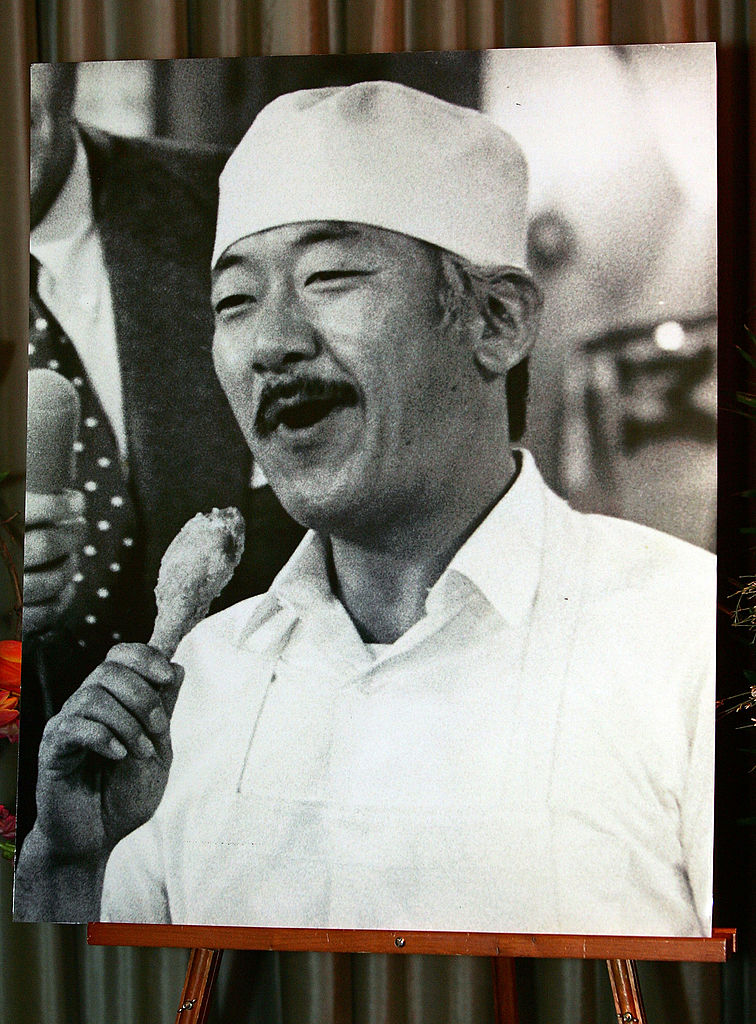
Morita went along with the request, but later had to explain that Arnold was Japanese-American after concerns were raised about the character being perceived as Chinese-American.
Fonzie’s big romance didn’t last
The fourth-season storyline Fonzie Loves Pinky was heavily promoted as Fonzie’s chance at finding true love. Pinky Tuscadero, played by Roz Kelly, was supposed to be the female counterpart to Fonzie. The storyline even received enormous publicity.
But the pairing didn’t work as planned, and Pinky was eventually written out of the series.
This Happy Days photo has a story most fans never knew
In 1983, a future TV star made a brief appearance on Happy Days — long before audiences knew her as one of television’s most recognizable actresses.
The episode, “Where the Guys Are,” follows Roger, Potsie and Chachi as they try to help Fonzie get over his breakup with Ashley. Their solution? Sending the famously confident Fonz to a singles resort.
That’s where he meets Debbie, played by a young Janine Turner.
At the time, Turner was still at the beginning of her career. Years later, she would become best known for playing Maggie O’Connell on Northern Exposure, as well as roles in Cliffhanger and Friday Night Lights.
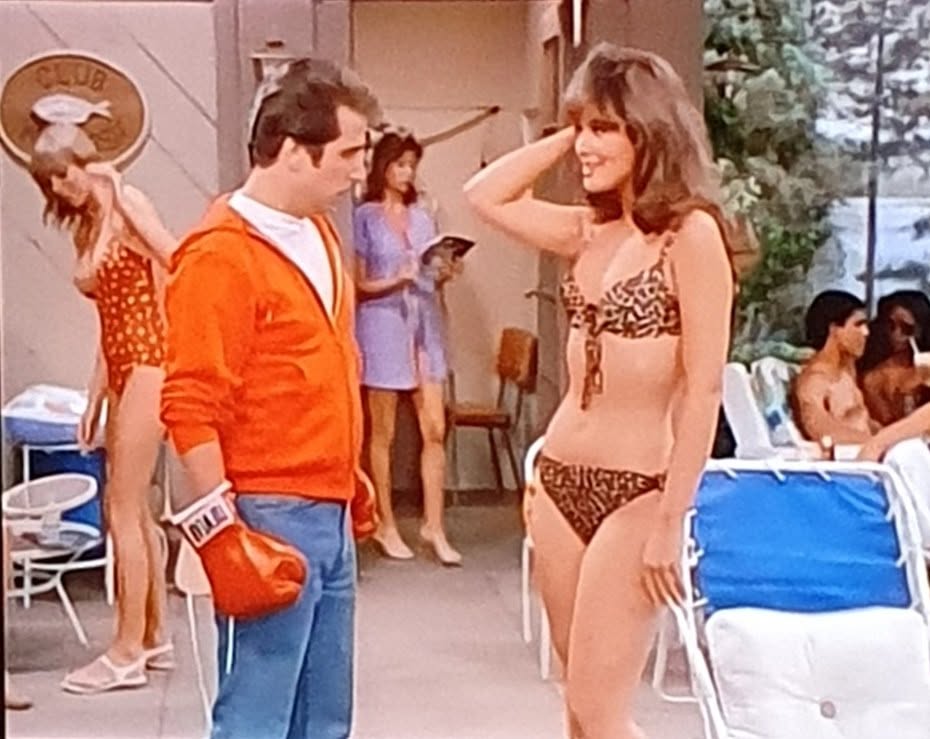
So the photo of Turner alongside Fonzie may look like nothing more than a fun piece of Happy Days nostalgia.
But there’s another side to it.
Turner later spoke about becoming frustrated with the kinds of roles she was repeatedly offered, particularly what she described as “bikini roles.” She eventually stopped accepting them — a decision that came at a steep financial cost. At one point, she said, she was down to her last $8 before landing the role of Maggie O’Connell.
That’s what makes this old Happy Days photo more interesting than it first appears.
It’s a snapshot of an actress who hadn’t yet become a household name — and of a very different time in Hollywood, when women could find themselves judged more for their appearance than their talent.
The clever Ron Howard joke Happy Days fans missed
I don’t know how many Happy Days fans caught this one, but it’s such a clever little joke.
In one episode, the Cunningham family walks out of a theater after watching The Music Man. Mrs. Cunningham notices the young boy in the movie and points out that he looks exactly like Richie did as a child.
Mr. Cunningham dismisses the idea, insisting that the boy looks nothing like their son. But here’s the fun part: he actually was Richie. The little boy on the screen was played by Ron Howard himself when he was just eight years old. He portrayed Winthrop Paroo in the 1962 film, years before he became Richie Cunningham.
John Lennon once showed up
Imagine being on the Happy Days set and suddenly seeing a former Beatle walk through the door.
That’s exactly what happened in 1975 when John Lennon unexpectedly visited the Paramount lot with his son, Julian, who was reportedly a big fan of the show.
Lennon spent time meeting cast members, signing autographs and chatting with people behind the scenes.
The show helped launch Robin Williams
Before Robin Williams became one of the world’s biggest comedy stars, he was a relatively unknown stand-up comedian.
Garry Marshall needed someone to play the eccentric alien Mork from Ork. Marshall’s sister, Ronny, recommended Williams after seeing him perform on the streets.
Williams eventually appeared as Mork, and his wildly unpredictable performance was so memorable that the character received his own spinoff, Mork & Mindy.
Even the names had real-life connections
Some of the show’s most recognizable names weren’t completely invented.
Garry Marshall’s wife had gone to school with someone named Potsie Webber, while Richie Cunningham was the name of a “nice boy” Marshall knew from church.
Even Fonzie almost had a very different name. Marshall originally considered naming him Arthur Masciarelli, using his own family’s original surname.
Thankfully, “the Fonz” won out.
The phrase “jump the shark” was born here
One of television’s most famous expressions came from Happy Days.
In the episode where Fonzie waterskis over a shark, Henry Winkler actually performed most of the stunt himself. The one thing producers wouldn’t allow him to do was the actual shark jump.
The moment eventually became so infamous that “jump the shark” entered popular culture as a phrase for the point when a television show becomes overly outrageous.
A tiny Happy Days goof fans may have missed
In the pilot episode, the gang hangs out at a diner called Arthur’s. But when the series returned for its regular run, the name had mysteriously changed to Arnold’s — the iconic hangout fans would come to know and love.
The cast wasn’t just a cast
Garry Marshall wanted the actors and crew to have fun together away from the cameras too.
He helped organize a Happy Days All-Star Softball Team made up of cast and crew members. They played other celebrity teams, raised money for charity and even traveled to military bases in Europe and Japan.
That camaraderie became another part of what made the Happy Days years so special.
And perhaps that’s why, all these years later, the sight of Fonzie straightening his leather jacket or Richie walking into Arnold’s can still bring back that unmistakable feeling of being young and watching Happy Days with the people you loved.
Henry Winkler called out one Happy Days actor
Although the atmosphere among the Happy Days cast was generally warm and supportive, Henry Winkler recently revealed that one recurring guest actor apparently let his growing fame go to his head.
While the cast largely viewed themselves as an ensemble, Winkler remembered one actor who repeatedly talked about how much fan mail he was receiving.
“I got 50,000 letters a week,” Winkler recalled telling him. “We don’t talk about that on the set. We are all here as one.”
But the actor apparently didn’t take the hint.
“And he kept doing it, and he was an assback,” Winkler said.
Winkler initially refused to reveal the actor’s name, giving fans just one clue:
“He played Eugene.”
That clue quickly pointed fans toward Denis Mandel, who played Eugene Belvin during the later seasons of the beloved sitcom.
Fonz’s famous jacket
And speaking of Fonzie’s famous jacket… it almost never became part of his look.
When Happy Days debuted in 1974, ABC initially refused to let Henry Winkler wear a leather jacket as Fonzie. Network executives felt that leather carried a “hoodlum” image, so Fonzie was given a blue windbreaker instead.
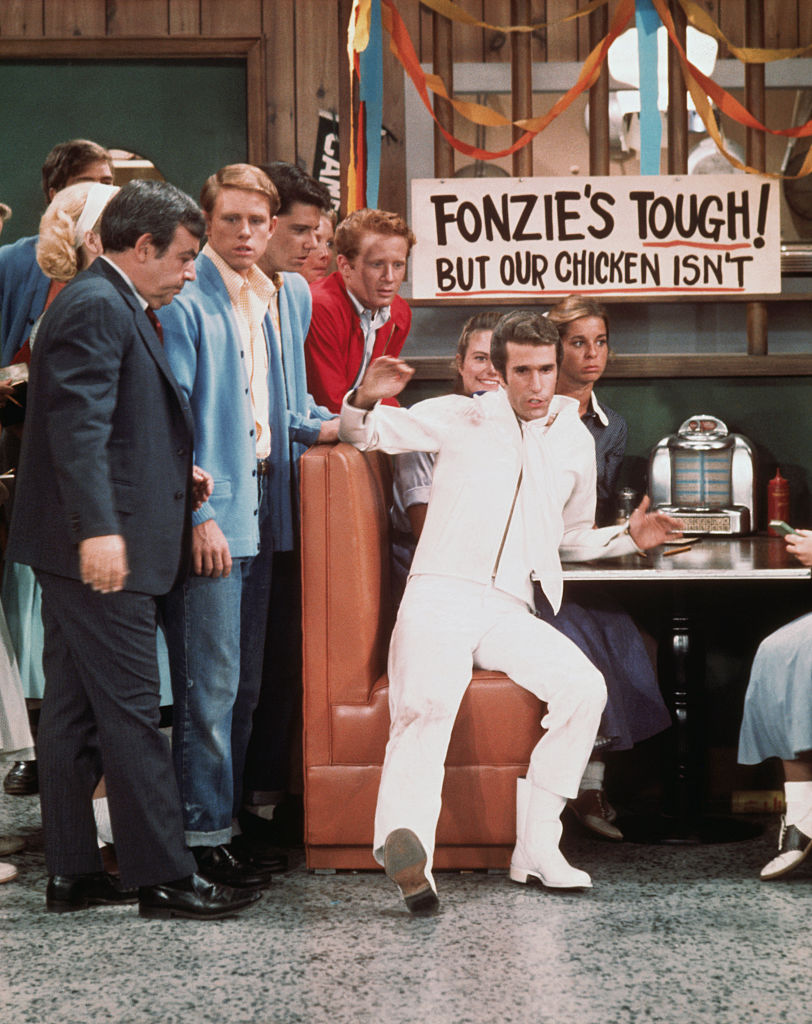
But that didn’t last forever.
Starting in the second season, Fonzie finally got the brown leather jacket that would become inseparable from his character — and eventually one of the most iconic pieces of clothing in television history.
Five jackets were reportedly made for the series. One is now part of the Smithsonian collection, while another belongs to Winkler himself.
The emotional moment Happy Days fans never forgot
In the final episode of Happy Days, Tom Bosley briefly stepped outside his role as Howard Cunningham and spoke directly to the audience.
Breaking character, he thanked viewers for welcoming the Cunninghams into their homes and for being part of the family throughout the show’s many years on television.
It was a simple but heartfelt goodbye — and a fitting way to close the chapter on a series that had become part of so many viewers’ lives.
READ MORE
- Little-known mistakes and bloopers in M*A*S*H
- Night Shift: Surprising secrets about the 80s cult comedy