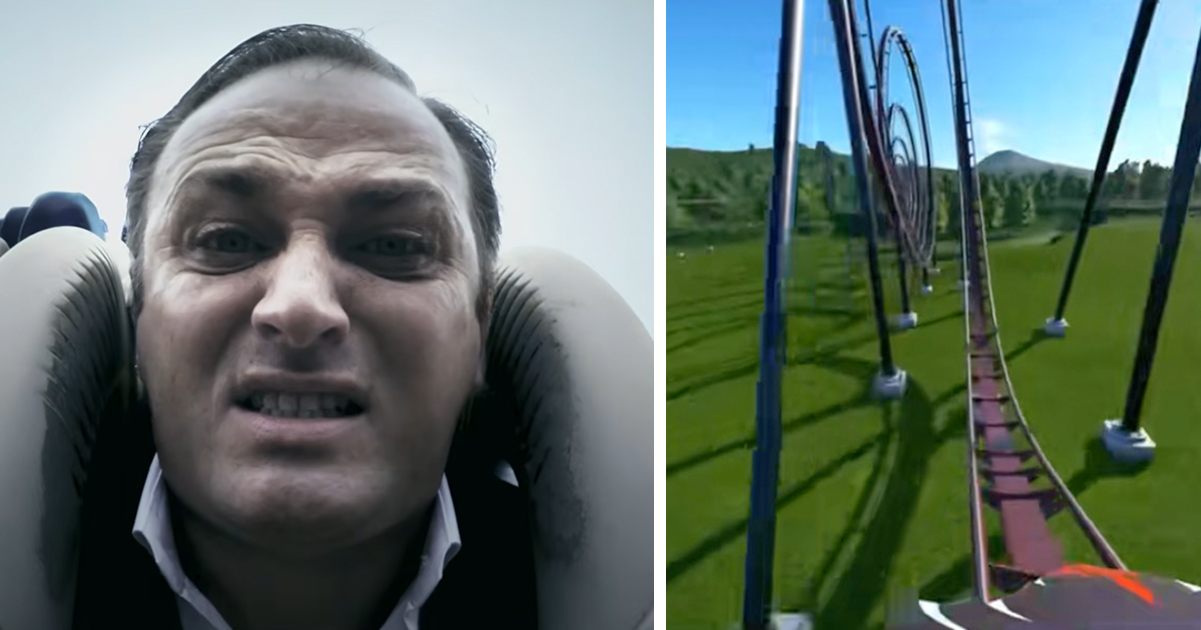
A TikTok simulation letting viewers ‘experience’ a theoretical euthanasia rollercoaster has gone viral.
A video simulation offering a realistic look at how a euthanasia rollercoaster ride would actually work has gone viral. The ride is designed to kill everyone onboard.
The rollercoaster was first conceived in 2010 by Lithuanian designer Julijonas Urbonas as a hypothetical art project while he was a PhD candidate at the Royal College of Art in London.
He described it as a machine engineered to “humanely, with elegance and euphoria, take the life of a human being.”
It has never been built, but a scale model was unveiled in 2011 at Dublin’s Science Gallery and the concept has fascinated and disturbed people ever since.
The simulation now circling on TikTok has brought the concept to a new audience.
How exactly the rollercoaster would work
The simulation begins with a slow ascent to 510 feet, just shy of the height of America’s tallest building. At the peak, riders are given a final choice: descend safely, or continue.
Those who choose to continue must manually press a button to initiate the drop.
What follows is a series of loops engineered with progressively smaller diameters, designed to maintain a constant force of 10Gs throughout. For comparison, Formula 1 drivers experience just over 6Gs during sharp turns, and Apollo 16 astronauts encountered 7.19Gs during re-entry into Earth’s atmosphere.
The effect on the human body would be rapid and fatal. Blood rushes away from the brain, causing oxygen deprivation to the brain. Vision would first grey out, then narrow to a tunnel, before darkness sets in entirely.
“You would begin experiencing a blackout, and ultimately you would eventually lose consciousness and die.”
A broader conversation around engineered euthanasia
The rollercoaster belongs to a wider conversation about engineered methods of assisted dying. Another concept that has attracted significant attention is the Sarco capsule, developed by Dr. Philip Nitschke of euthanasia advocacy group Exit International. The Sarco capsule is a 3D-printed pod activated. The person using it can from the inside activate it which leads to the pod flooding with nitrogen to reduce oxygen levels rapidly.
Nitschke has described the experience as causing mild disorientation and possible euphoria before loss of consciousness.
Urbonas’ rollercoaster won the Public Prize of New Technological Art at Update 2013 and has been described by its creator as a “unique media phenomenon,” a piece of design that forces a conversation about death, dignity and the ethics of assisted dying without ever having to turn a single wheel.
READ MORE:
- First child under 12 dies by euthanasia after Netherlands expands assisted-dying law
- 16 volunteers recreate 12×12 room showing conditions endured by ‘feral’ children in Ohio ‘house of horrors’