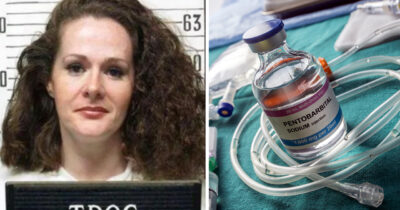
What happens if someone survives their own execution?
That is the extraordinary question now surrounding Christa Pike after Tennessee administered two rounds of lethal-injection drugs — yet she was still alive.
Christa Pike, 50, had spent around three decades on death row before being brought into the execution chamber at Riverbend Maximum Security Institution for the 1995 murder of 19-year-old Colleen Slemmer.
She was set to become Tennessee’s first woman executed in more than two centuries, according to historical records.
But after receiving two rounds of lethal-injection drugs, Pike did not die.
She was instead transported to an off-site medical facility, according to a Tennessee Department of Correction spokesperson cited by NBC News. Her attorneys later confirmed that she was being treated at a hospital, although they said they did not yet know her condition.
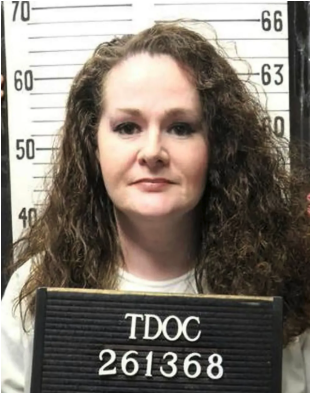
The execution began shortly after 7:26 p.m. on September 30, but witnesses soon realized that the procedure was not unfolding as expected.
Then, around 7:34 p.m., Pike reportedly said:
“My arm feels like it’s about to burst open.”
She then asked:
“Does this happen like that?”
The curtain was eventually closed, leaving witnesses unable to see what was happening inside — but some said they could still hear Pike breathing and making noises that sounded like snoring.
More than two hours after witnesses entered the chamber, an ambulance was seen leaving the prison with its lights on.
Pike had survived.
She was taken to an off-site hospital after her lawyers requested immediate medical treatment, with her attorneys later saying the execution had “failed.”
But what happened next could be even more complicated.
Tennessee’s execution protocol allows a second round of lethal-injection drugs if an inmate has not been determined to be dead following the first round.
Pike received that second round.
And she still survived.
The state’s protocol, however, does not specify what officials are supposed to do if both rounds fail.
Tennessee has now suspended all remaining scheduled executions for the year while a third-party review investigates exactly what happened.
For now, Pike remains under a death sentence, but she has no new execution date.
Her lawyers are expected to challenge any attempt to carry out the sentence again, potentially raising constitutional arguments over whether another execution attempt would amount to cruel and unusual punishment.
A small number of cases
There have been a small number of cases in U.S. history where an execution attempt failed and the prisoner survived. What happened afterward varied considerably depending on the case and the legal ruling.
Here are some of the clearest examples:
Willie Francis — survived once, executed a year later
One of the most famous cases involved Willie Francis in Louisiana. In 1946, the state attempted to execute him in the electric chair, but the equipment had apparently been improperly set up. Francis was badly shocked but survived.
He was returned to death row while his case went through the courts. The U.S. Supreme Court ultimately ruled in 1947 that executing him a second time would not violate the Constitution’s protection against double jeopardy.
One year and six days after the failed attempt, Francis was strapped back into the electric chair and successfully executed. He was only 17 at the time of the second execution.
Doyle Hamm — survived, but was never executed again
A much more recent example is Doyle Lee Hamm in Alabama.
In 2018, officials attempted to execute Hamm by lethal injection. Execution personnel struggled to establish an IV, and the attempt was eventually abandoned after the procedure had gone on for hours.
Hamm survived the execution attempt.
His attorneys subsequently argued that another attempt would subject him to unconstitutional pain and suffering. Alabama ultimately reached a confidential agreement with Hamm’s lawyers under which the state would not attempt to execute him again.
Hamm remained on death row until his death from cancer in 2021.
Romell Broom — execution abandoned, but the state tried again
Romell Broom, an Ohio death-row inmate, survived an attempted lethal injection in 2009 after execution personnel spent roughly two hours unsuccessfully trying to establish an IV.
The execution was eventually called off.
Unlike Hamm, however, Ohio subsequently attempted to schedule Broom for another execution. His lawyers challenged the second attempt, arguing that forcing him through another execution after the first failed would violate the Constitution.
Broom ultimately died in prison in 2020 before the state could execute him.
READ MORE
- What witnesses saw after curtain rose in failed attempt to execute Christa Pike
- These were meant to be Christa Pike’s final words