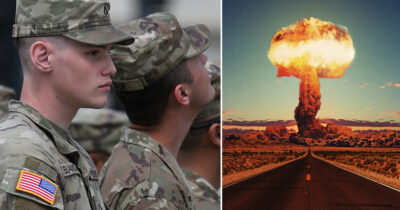
Millions of American men face a sweeping change to military draft registration this December, raising urgent questions about their options if World War III forces the US to call civilians into service.
Under legislation signed by President Donald Trump in December 2025, the Selective Service System (SSS) is preparing to automatically register eligible men for a potential military draft, replacing a system that has relied on individuals signing themselves up for decades.
Currently, all men aged 18 to 25 must register within 30 days of turning 18, while women are excluded under federal law.
The new process, scheduled to take effect by December 19, 2026, shifts that responsibility to the federal government, which will use existing records to identify eligible individuals.
However, registration does not mean anyone is being drafted. The US has not enforced compulsory military service since 1973, and reinstating it would require authorization from Congress and the president.
Still, the approaching deadline raises an important question about the choices Americans would have if war brought back the draft.
Six options if Americans are drafted
Under existing Selective Service System (SSS) rules, “men called for induction would be able to make a claim for deferments, postponements, or exemption from serving” – depending on their circumstances.
1. Object to military service
Those whose religious or moral convictions prohibit participation in war could apply for conscientious objector status. They might be assigned noncombat duties or civilian work, although opposition to a particular conflict would not qualify.
However, the SSS notes that “Men cannot pre-classify as a conscientious objector. In the event of a draft, men who are called for induction would be able to submit a claim for conscientious objector classification.”
2. Fail medical requirements
Before entering military service, recruits would undergo medical evaluations. Anyone whose health or disability prevents them from meeting the required standards could be ruled ineligible.
3. Demonstrate family hardship
Someone whose departure would leave dependents without essential care or financial support could request a deferment. Marriage or parenthood alone, however, would not be enough.
4. Qualify for another exemption or postponement
Certain reservists, religious ministers and ministry students may receive special classifications. College students could also qualify for temporary delays, but enrollment would not automatically excuse them from service.
5. Appeal a classification
Americans who believe their circumstances were incorrectly assessed could challenge the decision through the SSS appeals process, providing evidence for a review.
6. Induction evasion
Ignoring an induction order is a federal crime under the Military Selective Service Act. Anyone who knowingly disobeys a lawful order could face criminal prosecution, fines or imprisonment.
Ultimately, these six possibilities do not guarantee freedom from military service. While some provide lawful ways to delay or avoid induction, refusing to comply could carry serious consequences.
What do you think about military draft registration being mandatory for men but not women? Please let us know your thoughts and then pass this story along so we can get the conversation going!
Read more: