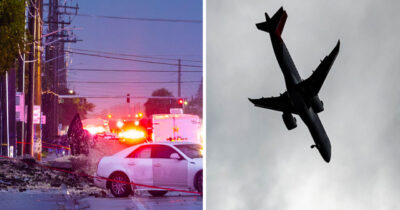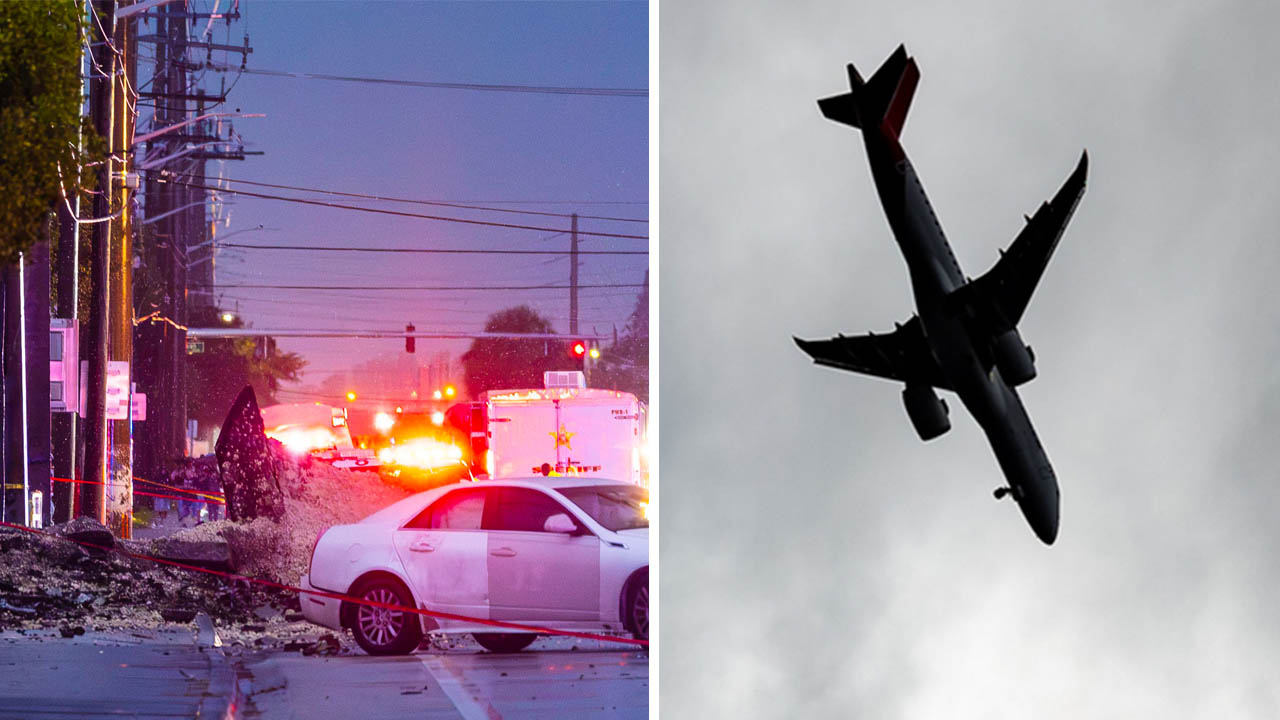
Investigators have found parts of the Learjet’s tail miles from where it crashed in Florida, killing all nine people on board. Now aviation experts are sharing their theories about what caused the deadly plunge.
A week after a private jet fell from the sky over Palm Beach County, Florida, investigators and aviation experts are slowly piecing together what went wrong.
The Learjet 60 was flying from Austin, Texas, to the Bahamas on Sunday, November 1, when it went into a rapid descent from around 35,000 feet and crashed into a residential area. All nine people on board were killed.
The victims were tech entrepreneur Adam Robinson, 44, his wife Helen Sharp, their children Emma, four, and Charlie, two, their nanny Anita Maria Ramirez Cetina, family friends Rachael Reed and Charmi Fehr, captain Jeff Gregory, 55, and co-pilot Nathalia Gadelha Filgueiras, 20.
Parts of the tail were found miles away
According to the NTSB, most of the jet’s left elevator, a movable part of the tail that controls the plane’s pitch, was found in three pieces. Some of them were as far as 3.8 miles from the crash site. NTSB board member Tom Chapman said the pieces were “quite some distance away,” which means they came off before the plane hit the ground.
“Knowing that it was lost is a very important piece of evidence in terms of pointing us towards other things to investigate,” he said. He added that the weather is “a key focus of the investigation.”
Not everyone agrees on what that means. Aviation safety expert Jeff Guzzetti told the AP he believes the elevator broke off because of the nosedive, not the other way around. If it had come off at high altitude, he said, the debris would have been spread much further away.
Former NTSB member John Goglia has another theory. He told The Guardian that tracking data seems to show the jet leveling off for a few seconds at around 8,000 feet before diving again.
“He apparently leveled off for brief moments at 8,000ft and to accomplish that he likely overstressed the tail and the horizontal stabilizer separated from the airplane,” Goglia said. Meanwhile, Law&Crime has pointed to freeze frames from videos of the crash that appear to show the entire horizontal stabilizer missing before impact. That has not been confirmed.
The weather and the crew’s schedule
Retired pilot Captain David Funk told Law&Crime that it “takes a lot of force to pull an elevator off the airplane,” and that the jet would have had to be “overstressed.”
He said that above 30,000 feet, “severe turbulence and rapidly developing clear icing is a possibility.” If the plane went too fast or too slow, he explained, it could stall or go into a “Mach tuck,” where the nose pitches down.
According to Funk, investigators will also look at the pilots’ training records and recent schedules.
“Were they overly fatigued? Have they had long day after long day with short nights between them?” he said. The jet’s maintenance history, including any past repairs or cracks in the tail, will also be checked.
Read more: