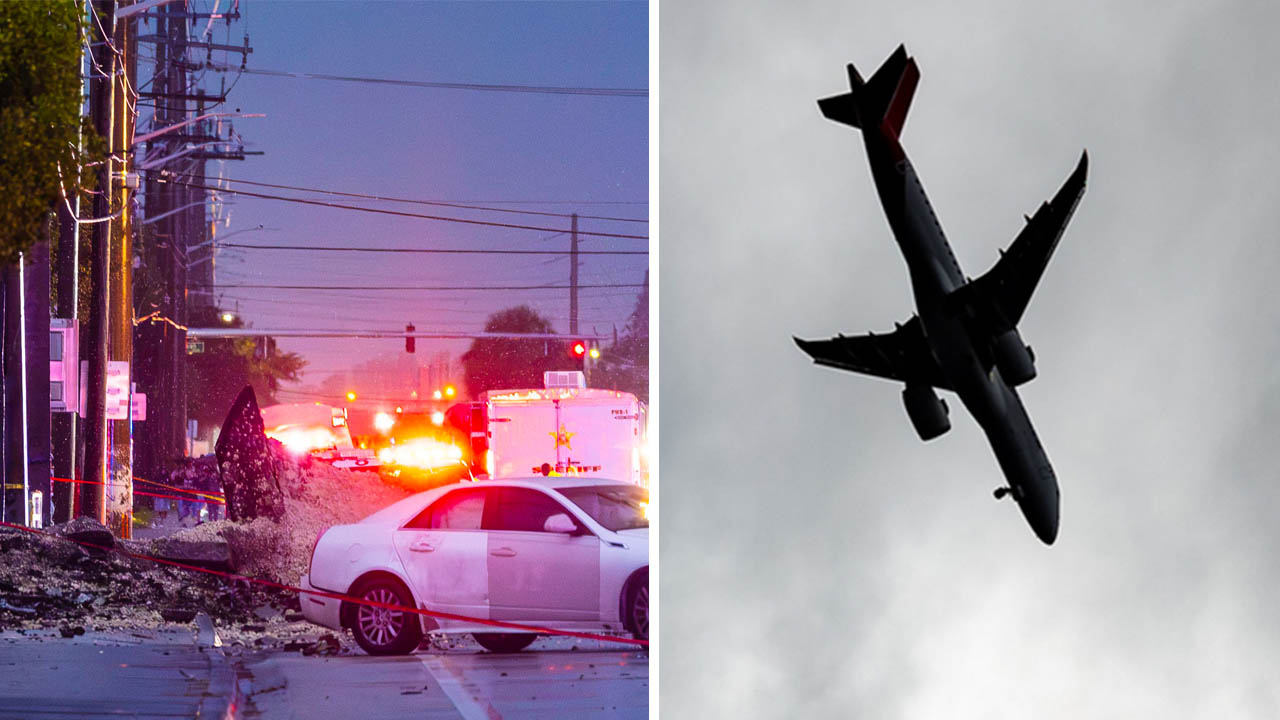
A new 3D animation recreates the last 68 seconds of the Learjet 60 that crashed in Palm Beach County, killing all nine people on board. It shows how quickly the jet went from cruising altitude to a spiraling dive.
A new 3D animation shows just how fast everything went wrong for the Learjet 60 that crashed in Palm Beach County, Florida, on Sunday, November 1.
All nine people on board died when the Bahamas-bound plummeted 35,000 feet into a residential area. Among them were tech entrepreneur Adam Robinson, 44, his wife Helen Sharp, their children Emma, four, and Charlie, two, their nanny Anita Maria Ramirez Cetina, and family friends Rachael Reed and Charmi Fehr.
Captain Jeff Gregory, 55, and co-pilot Nathalia Gadelha Filgueiras, 20, were also killed.
What the animation shows
The video, posted on the YouTube channel AP Way, recreates the flight’s final moments using air traffic control recordings, the plane’s ADS-B tracking data and weather radar from that day. It’s worth noting this isn’t an official reconstruction, and the NTSB has not yet determined what caused the crash.
The jet had taken off from Austin, Texas. Over Palm Beach County, with rain ahead, the crew asked to climb higher. According to the animation, the plane topped out at 35,450 feet. Seconds later, it started to drop.
“Six seconds later, the jet is coming down at more than 3,000 ft a minute. 10 seconds after that, 14,000 ft a minute. The nose is down and the speed is building fast,” the narrator says.
The jet then began turning right, first slowly, then more sharply, until it was spiraling down. Its ground speed passed 500 knots, close to 600 mph. “Overspeed means faster than the jet was built to fly. The controls get heavy, and the nose can tuck further down,” the narrator explains.
The co-pilot’s final calls
The animation is set to real audio from the cockpit’s radio calls. “We’re descending 8,000 – mayday, mayday – we’re descending 10,000 feet per minute,” Filgueiras can be heard saying.
Moments later, she adds: “We are in an overspeed condition, descending 20,000 feet per minute.” Air traffic control stays calm, telling the crew to “let me know what you need”. But the plane was losing around 7,000 feet every 10 seconds.
“We are descending 22,000 ft, and we are banking 60°,” Filgueiras says in one of her last transmissions. The transponder’s final altitude reading was 8,750 feet, just 68 seconds after the jet reached the top of its climb.
What investigators know so far
The NTSB says most of the plane’s left elevator, a key part of the tail that helps control its pitch, was found in three pieces, some as far as 3.8 miles from the crash site.
Investigators have said there are early signs the jet may have started breaking apart before it hit the ground. The crew had also reported ice and turbulence shortly before the emergency.
A final report could take a year or more.
Read more: