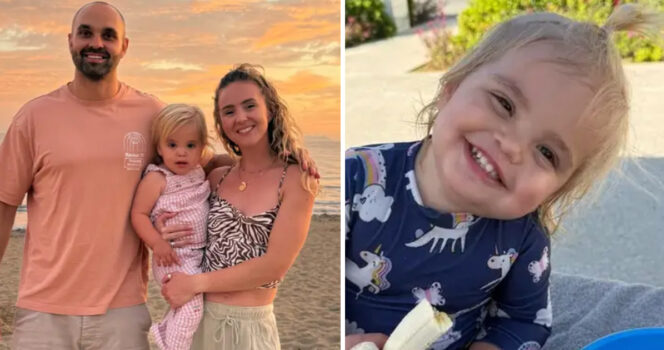
A two-year-old described as a “bundle of energy” has been diagnosed with a rare form of childhood dementia, and now her parents fear that “time is running out to save her life.”
Only one week before her second birthday, little Leni Forrester was diagnosed with Sanfilippo Syndrome Type B, a rapid neurodegenerative condition also known as childhood dementia.
Her parents, Emily, 33, and Gus, 35, said they were completely blindsided by the diagnosis: “We didn’t have any concerns at all about Leni,” the Kent mother told the Mirror, describing her daughter as “sunshine.”
‘Catastrophic genetic condition’
The first indication that something might be wrong came unexpectedly during a routine genetic screening connected to Emily’s sister, who was found to be a carrier for the NAGLU gene linked to the condition.
Although the chances of their child being affected were extremely small, the mom and dad chose to undergo testing as a precaution.
At first, a medical test gave them the “all-clear,” reassuring the couple and encouraging them to consider expanding their family.
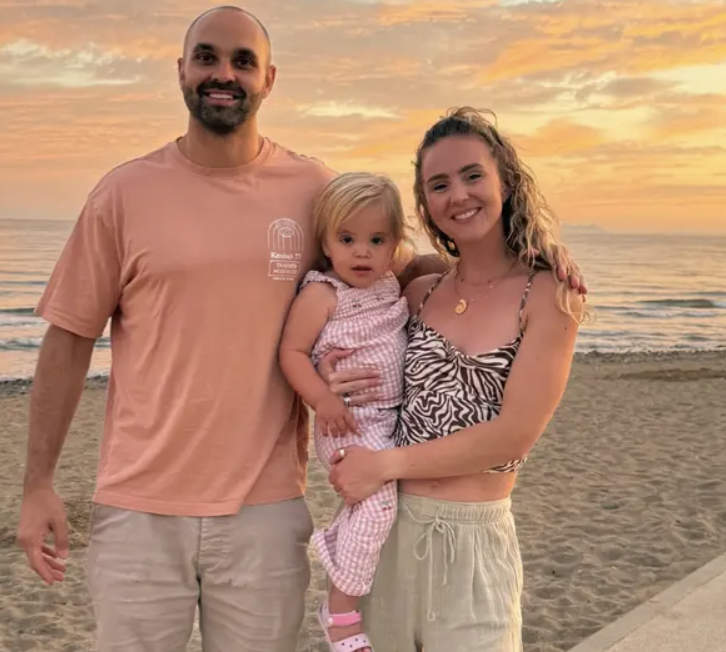
But further testing revealed the tiny tot had Sanfilippo syndrome, a “catastrophic genetic condition.”
‘Symptoms lead to premature death’
Sanfilippo syndrome is caused by an enzyme deficiency that prevents the body from breaking down certain complex molecules. As these substances accumulate, they create toxic waste that progressively damages brain cells.
According to the Cleveland Clinic, “It causes a variety of cognitive (mental), behavioral and physical symptoms that get worse over time. These symptoms lead to premature death.” The condition is extremely rare, affecting an estimated one in every 50,000 to 250,000 people.
Children with Sanfilippo syndrome often appear healthy in early childhood, with symptoms typically emerging around 3. Over time, affected children gradually lose the ability to speak, walk, eat and communicate.
“All your dreams for your child’s future are taken away,” Emily told ITV News on March 23, 2026 – five months after Leni was diagnosed. “It’s completely earth-shattering. It is every parent’s worst nightmare.”
Unexpected signs
Looking back, Emily says the signs were so subtle that they were easy to attribute to normal variations. Leni has distinctive features such as bushy eyebrows, but these never raised concern at the time.
Emily explained, “both me and my husband have bushy eyebrows, so it’s not that unusual.” Other characteristics sometimes associated with the disorder could also be seen in Leni’s face, including “thick eyelashes, full lips,” but they were not pronounced enough to signal a serious condition.
Leni was also born with talipes, a condition that caused her feet to turn inward, but physiotherapy corrected the issue, meaning there was no clear reason to suspect an underlying genetic disorder.
“But because of how this syndrome progresses, they don’t really have any obvious symptoms that are different to what a normal toddler might experience before they’re 2 years old,” Emily explained, adding that the early signs were “nothing that you would piece together as this catastrophic genetic condition.”
‘She will suffer’
Without treatment, the disease will continue to damage Leni’s brain cells over time.
“Every day that passes without treatment, this toxic waste is building up in our child’s body,” Emily said. “If we can’t get treatment, she will suffer the most awful physical and mental decline you can imagine and then die in her early to mid-teens.”
When doctors first delivered the diagnosis, the family were told there was no approved treatment available in the UK, leaving them facing the devastating reality of palliative care.
It’s “obviously horrific,” Emily told the Mirror.
‘Damage cannot be reversed’
Now, however, there is hope in the form of a potential gene therapy currently being developed by Professor Brian Bigger at the University of Edinburgh. The treatment aims to deliver a healthy copy of the missing gene into patients’ blood stem cells, offering the possibility of slowing or preventing further damage caused by the disease.
But time is critical.
“We’re racing against time,” Bigger told ITV. “She will start to lose brain cells and when that happens, we’re not going to get them back.”
Emily says early intervention could make a life-changing difference.
“Early treatment is key for these children. The damage cannot be reversed once it’s done,” she said. “If she has to wait six months, that could mean she can no longer talk. If she waits 12 months, that could mean she loses the ability to walk.
‘Time is working against us’
“With Leni’s condition everyday matters and time is running out to save her life,” Emily writes in a GoFundMe campaign organized to help raise funds for the treatment. “It is every parent’s worst nightmare to be told that their child is going to die, and that is the haunting reality we are faced with if Leni cannot get access to treatment and fast. We will do anything we can to save our baby girl.”
“Time is working against us,” she shared, adding, “This truly is her only hope.”
Share your best wishes for Leni and her family in the comments, and share this story to help raise awareness of Sanfilippo syndrome. Every share helps more people understand this rare condition.
READ MORE
- Ellen DeGeneres shares news on triple diagnosis
- John Cena issues warning about signs of cancer after his heartbreaking diagnosis