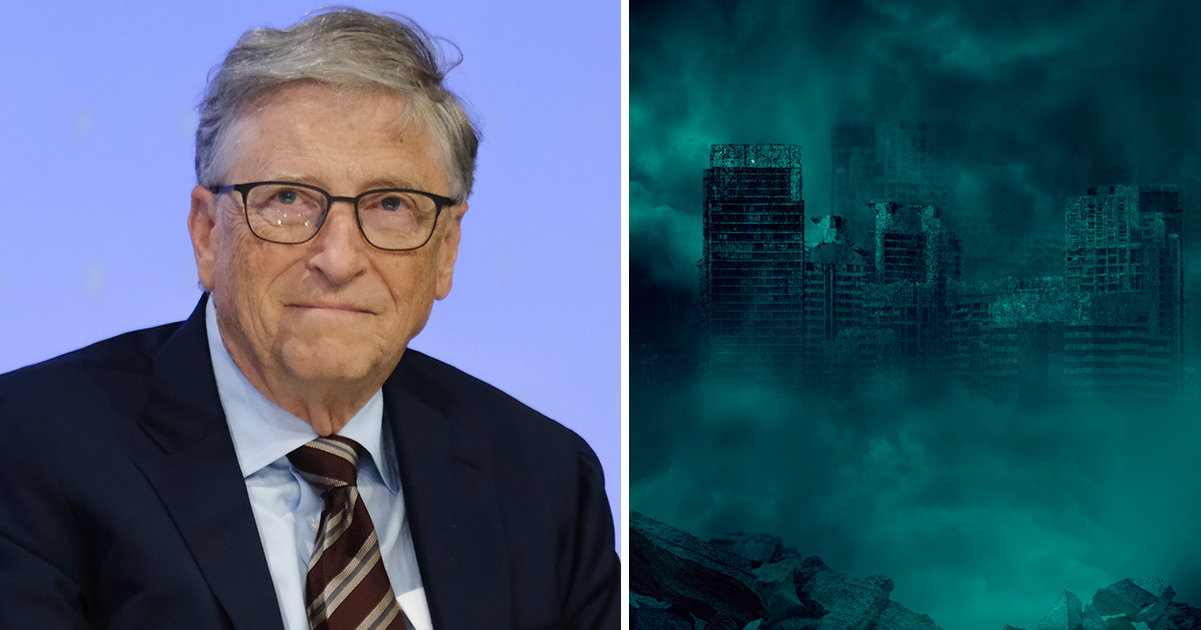
AI can already “see, listen, speak and reason,” and Bill Gates warns it will eventually perform physical work “just as smoothly as any human” – leaving only three professions safe from the technology that he calls the “greatest problem humanity has ever faced.”
The possibility that artificial intelligence (AI) could one day kill all humans sounds like science fiction, but inside one of the world’s leading AI companies, the people working to keep increasingly powerful systems under control are taking that threat seriously.
“The people building AI earnestly believe that it could kill us all by the end of the decade. This is not a marketing stunt,” former Anthropic researcher Jacob Coxon wrote on X. “No other human activity poses this level of danger.”
It was a chilling claim, but rather than dismiss it, one of the people responsible for researching how to keep Anthropic’s increasingly powerful AI systems aligned with human interests publicly backed him up.
“We really do earnestly believe AI could kill all humans! I personally think it is >10% within the next decade,” Evan Hubinger, Anthropic’s Alignment Science Lead, warned on X. “I believe Anthropic is trying its best, but we do not yet have a plan to solve alignment for superintelligence and are not clearly on track to.”
Hubinger later made an important distinction, explaining that “the risk from present models is low,” with his concern focused instead on a future in which increasingly advanced AI learns to improve itself.
“What I am worried about is superintelligence arising from recursive self-improvement, as we have said is happening faster than we thought,” he wrote.
For Coxon, 27, those fears had already become serious enough to walk away from the company helping build the technology.
‘Gambling with our lives’
“I resigned from Anthropic today. I spent the last three years doing pretraining research at both OpenAI and Anthropic. Neither company is acting responsibly,” shared Coxon on Sept. 8, the same day he resigned.
“They are racing straight to self-improving superintelligence and gambling with our lives,” he continued.
Speaking with the Wall Street Journal on Sept. 9, Coxon explained that the race is moving so quickly that, under some of the “most aggressive scenarios,” “by the end of next year things could be out of control already.”
His resignation adds to growing unease inside an industry racing to build systems that researchers warn may eventually become extraordinarily difficult to control.
‘Greatest problem humanity has ever faced’
And while the worst-case scenario is nothing less than human extinction, Bill Gates has been sounding the alarm over another upheaval AI may bring much sooner – one that could transform how millions of people make a living.
At the Telluride Film Festival in early September, the Microsoft co-founder addressed the growing risks during a panel discussion, asking, “Is this the greatest problem humanity has ever faced?” before adding, “That is just a fact.”
Only days earlier, Gates, 70, had warned that the world needs time to prepare for the disruption as AI becomes capable of taking on work once reserved for humans.
“I believe we need time to prepare for the period of social, political, and economic upheaval we are about to enter,” the billionaire philanthropist wrote in an essay shared on Gates Notes.
“The people who need the most time are the ones who have the least,” he wrote, explaining that a “$20-an-hour worker” risks being replaced by “a $10-an-hour robot.”
AI ‘can see, listen, speak, and reason’
“Because it can see, listen, speak, and reason and will eventually do physical work just as smoothly as any human, it will not just affect one sector. AI will take on work in law, customer service, medicine, software, and manufacturing,” Gates wrote in the Aug. 26, 2026 essay.
“It will hit these industries rapidly, over the course of a decade rather than a few generations. There will be some new jobs, but without the right policies there will be far fewer than exist today,” he added.
Only three jobs may be safe
Gates has long warned that AI won’t simply change the way people work but could dramatically reduce the number of tasks that require humans at all.
Speaking on The Tonight Show with Jimmy Fallon, Gates said he doesn’t believe humans will disappear from every part of life, joking that “we won’t want to watch computers play baseball.”
But when it comes to work, his outlook leaves surprisingly few professions untouched.
Three fields he has identified as particularly resistant to complete replacement are software programming, biology and energy, where human expertise would continue to play an important role even as AI becomes increasingly capable.
The irony isn’t lost on the first of those professions: the people building and refining AI may be among those best positioned to survive the disruption it creates.
How much do you think AI will change your life in the years ahead, and are you more excited about its potential or worried about the risks to jobs and society? Please let us know what you think, then share this story so we can hear how others feel about the rapidly changing technology!
Read more: