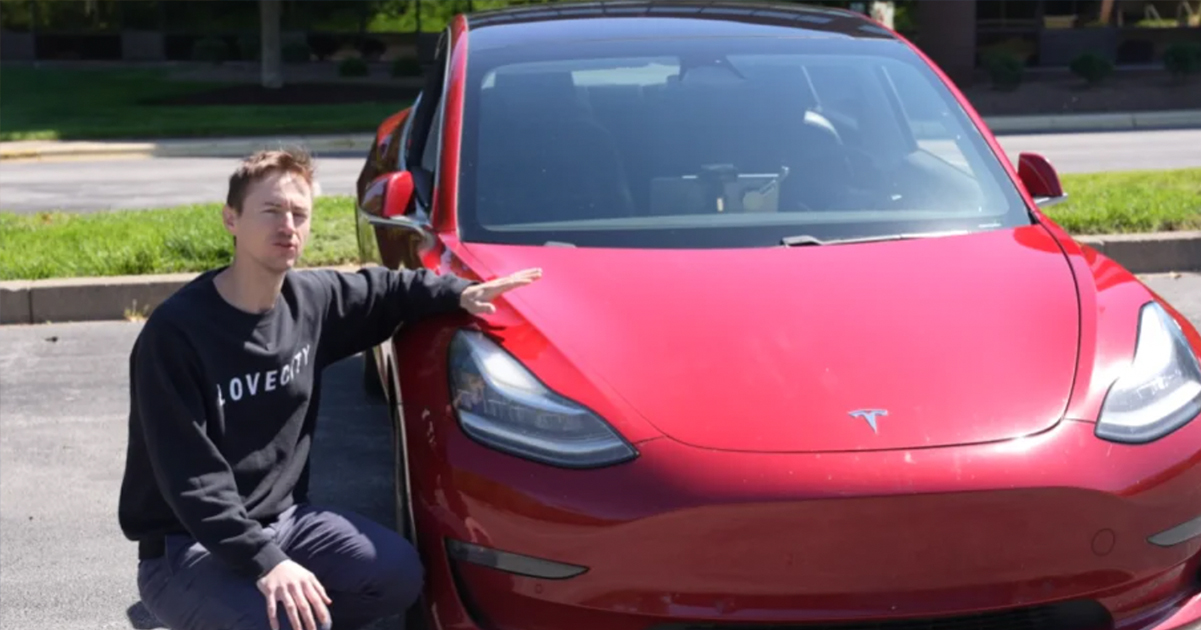
A Tesla owner tracked the cost of charging his car for 75,000 miles, then compared it with fueling a BMW for the same distance – and the difference was staggering.
Kentucky YouTuber Andy Slye bought his Tesla Model 3 in 2018 and started tracking how much electricity it took to keep the car on the road.
Three years and more than 75,000 miles later, Slye – who allegedly dated Taylor Swift in high school – went through the numbers to find out exactly how much he had spent charging the Tesla, then compared the total with what it would have cost to cover the same distance in his former gas-powered BMW 3 Series.
The comparison put a real-world price on a question that often comes with switching to an electric vehicle (EV): how much cheaper is it to plug in than fill up?
‘Wall to Wheels Efficiency’
Over 75,368 miles, Slye’s Model 3 recorded 18,656 kilowatt-hours of electricity flowing into its battery.
But that number didn’t tell the entire story.
Unlike gasoline pumped into a tank, not every bit of electricity drawn from the grid ultimately reaches an EV battery. Energy can be lost during charging, while a parked Tesla can also gradually lose some of its charge, Slye explained in his clip, adding this is called “Wall to wheels efficiency.”
Once Slye accounted for those losses, he estimated that his car had actually drawn approximately 20,728 kWh from the grid.
Then came the number that mattered: the bill.
Cost of 75,000 electric miles
Slye typically charged his Tesla at home overnight during cheaper “off peak” hours, and after factoring in his local electricity rates along with the Supercharging he used away from home, he calculated that powering his Model 3 for more than 75,368 miles had cost him approximately $1,404.
That works out to less than 2 cents in electricity for every mile driven.
There was, however, an important advantage working in his favor.
“Keep in mind the cost of electricity and gas depends on the geographic location. I’m located in beautiful horse and bourbon country also known as Louisville, Kentucky, so these numbers will reflect that, but of course they will be different depending on where you live,” he said, explaining that electricity was relatively inexpensive in his zip code.
Still, the comparison became considerably more striking when Slye ran the numbers for gasoline.
What if he’d driven a BMW?
Slye compared his Tesla with a gas-powered 2018 BMW 320i, estimating how much fuel the BMW would have burned while covering the same distance.
His calculation put the gasoline bill at approximately $9,353.
Against the $1,404 he calculated for charging his Tesla, he said “that’s $8,000 in fuel savings after 3 years,” and “close to $25,000” savings after another seven years.
But while the savings impressed Slye, viewers argued that the cost of electricity is only one part of the equation, particularly as energy prices continue to change.
Greenflation and accessibility
“With the current greenflation and the push for “sustainable” electricity, we will soon see insane electricity prices,” shared one critic, while a second wrote, “Electric costs will double to pay for the same taxes that fuel has. Government will Not let you drive without paying up.”
Others were less concerned about the price of charging than the question of where and how to do it, especially for drivers without easy access to a charger at home.
“Another problem is if you don’t own a house with a garage. You can fill up your gas tank in 5 minutes. A lot faster than going to a charging station and waiting for your 80% charge,” one netizen shared in the comment section.
Strained power grids
But charging access wasn’t the only practical concern, with others questioning how heavily drivers can rely on EVs in places vulnerable to prolonged outages or already-strained power grids.
“Lived in Florida years ago. During hurricane season one year, we were without power for 18 days, then 20 days,” one critic shared. “In California we have water shortage and power shortage problems. If more people drive electric cars, the power shortage problem is going to get worst,” wrote another.
What are your thoughts on electric vehicles? Do you think the savings make them a practical alternative to gas-powered cars, or do charging access and other challenges still outweigh the benefits? Please let us know what you think, then share this story with others so we can get the conversation going!
Read more: