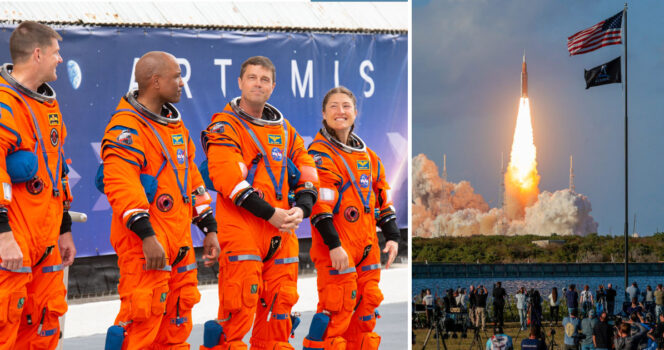
The crew of Artemis II has officially made history with an extraordinary trip to space and a seven-hour lunar flyby. But going to space isn’t something your body takes lightly – it can come with side effects once you return to Earth.
NASA astronauts Reid Wiseman, Victor Glover, and Christina Koch, alongside Canadian Space Agency astronaut Jeremy Hansen, are scheduled to return to Earth on Friday, April 10. The spacecraft will make a planned splashdown in the Pacific Ocean off the coast of San Diego at 8:07 p.m. ET (1:07 a.m. BST). Instead of landing on solid ground, the crew will descend by parachute into open water, where recovery teams will be waiting, according to Tyla.
Once they enter the planet’s atmosphere – “riding a fireball” at around 25,000 mph– they rely on an advanced heat shield to protect them from temperatures roughly half that of the sun. Helping them safely out of the spacecraft is a joint effort by NASA and the Department of War.
NASA-contracted engineer Jason Endley said: “Then that’s where my job comes in, of recovering the crew module alongside all the other NASA and Amentum employees we have on the ship,” according to UNILAD.
Artemis II landing
After their time in zero gravity, however, they may experience some side effects once they’re back home.
Kevin Fong, founder of the Centre for Altitude, Space and Extreme Environment Medicine at University College London, told the BBC: “In some experiments with rats, they’ve seen up to a third of muscle from particular muscle groups being lost within seven to 10 days of flight – that’s a huge, huge loss,” according to UNILAD.
To help prevent muscle loss, the crew reportedly follows scheduled workouts using a device known as a flywheel, similar to a multi-purpose rowing machine.
Hansen explained: “We can change the dynamics of this device so that we can do weightlifting with it. So we can do squats. We can do dead lifts. We can do curls. We can do high pulls.”
Initial medical checkups will be performed aboard a nearby naval vessel, the USS John P. Murtha, once the crew is back.
Being in space can also affect balance, with the inner ear becoming disrupted. Jasmin Moghbeli, who spent 200 days in space, said: “With eyes closed, it was almost impossible to walk in a straight line,” according to UNILAD.
Andreas Mogensen, also part of the same mission, said: “I felt wobbly for the first two days. My neck was very tired from holding up my head.”
The main side effect, according to Jeanette Epps, who spent 235 days in space, is getting used to the “heaviness” of Earth.
“You have to move and exercise every day, regardless of how exhausted you feel,” she said.
READ MORE
- Brandon DeWilde: The child star who died a very painful death at just 30
- Pope Leo makes grim 2-word statement on Donald Trump