
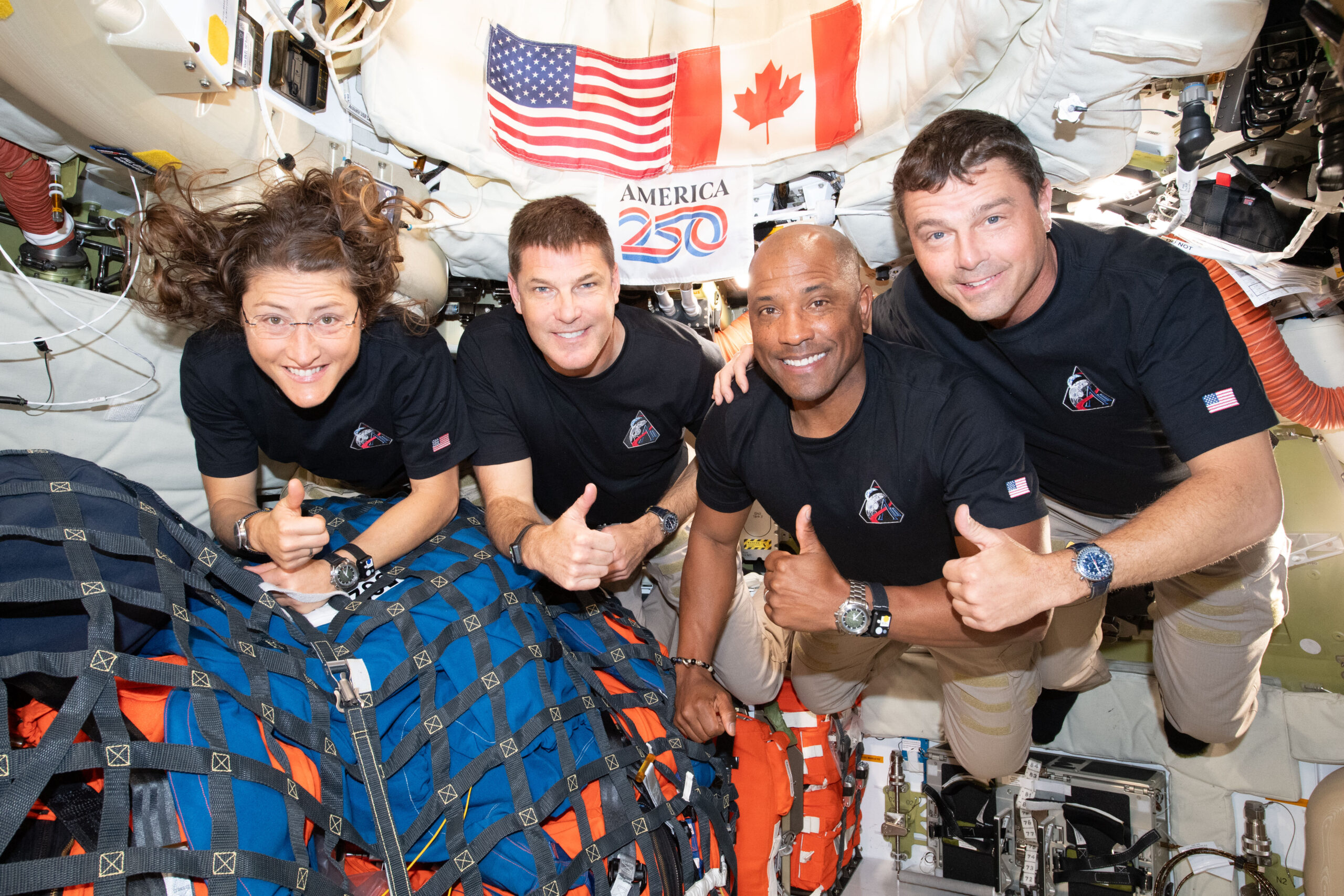
Much has quite rightly been made about Artemis II’s journey around the far side of the moon. Astronauts Victor Glover, Christina Koch, Jeremy Hansen, and Reid Wiseman set a new record for the farthest any humans have gone from Earth, reinvigorating mainstream public interest in space travel in the process.
The nine-day lunar flyby, launched by NASA on April 1, 2026, saw the first crewed flight venture beyond low Earth orbit since the Apollo 17 mission of 1972.
The mission itself served as a test of sorts, paving the way for subsequent Artemis missions that aim to place humans on the surface of the Moon within the next few years.
The crew splashed down successfully in the Pacific Ocean at 8:07 p.m. EDT on April 10, 2026, having flown an incredible 252,756 miles from Earth.
Yet though they returned unharmed from their iconic expedition, the crew members of Artemis II could well have undergone physical changes as a result of the nine days they spent in space.
If you’re wondering if there’s any potential toll exacted on the body after venturing farther into space than any other human ever, you’re not alone. The reported answer is that there are things that happen, and also effects that astronauts who go beyond Earth’s orbit may have to contend with in the future.
As per Sky News, such travel exposes astronauts to high-energy radiation. On Earth the atmosphere and planetary magnetic field provide protection via a shield known as the magnetosphere. Those who venture beyond said shield obviously lose the benefit of its protection.
This can result in astronauts having an increased risk of developing cancer, DNA damage, neurodegenerative effects, cardiovascular issues, and immune system dysregulation.
Dr Haig Aintablian, director of space medicine at UCLA, told Sky News: “Once you go beyond low Earth orbit, you lose much of the protection of Earth’s magnetic field.”
Not only that, but astronauts on extensive missions are known to feel the impacts of the lack of gravity on their bodies. This might not sound too serious on the face of it, but it can be more problematic than many realize.
“The body is built to live and work in gravity,” Dr Aintablian explained. “When that gravity signal is removed, the inner ear has to recalibrate, muscles and bones are used differently, and fluids shift upward toward the head.
“That is why we can see changes in balance, strength and, in some cases, vision.”
According to NASA, for every month a person spends in space, their weight-bearing bones become around 1% less dense if precautions aren’t taken. Astronauts can also experience muscle atrophy (the weakening of muscles) while away from the Earth.
Some astronauts also report experiencing headaches, motion sickness, dizziness, cardiovascular conditioning, and sleep disruption.
Fortunately, according to Dr. Aintablian, these effects seem to wear off over time after an astronaut has returned to Earth.
He added: “Some changes can take longer to recover from, and a few, particularly involving vision or bone, can persist beyond the mission.”
As for how NASA is tracking the physical changes experienced by the Artemis II crew, Dr. Aintablian said: “On a mission like Artemis II, doctors are tracking not just how the crew feels, but how their bodies are responding in real time.”
He added: “There are a broad set of checks, including blood and other biological samples, balance and vestibular testing, strength and cardiovascular assessments, sleep monitoring, and behavioural health evaluations.”
READ MORE
- Detail in Artemis II video sparks claim that mission is being faked with green screens
- Barron Trump announces unexpected new career move