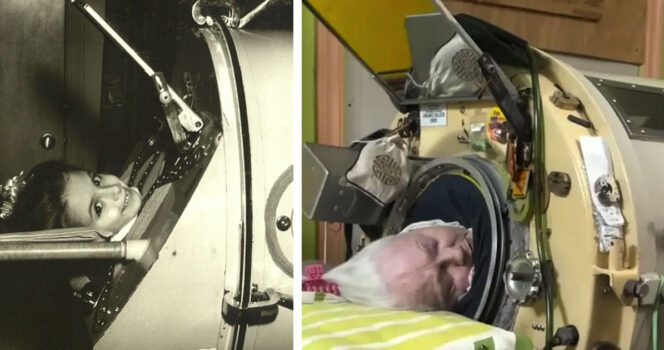
The last American polio patient to live in an iron lung has died at 78 and her machine was breaking down with no one left who could fix it.
Martha Ann Lillard got polio on her fifth birthday. She died 73 years later still dependent on the iron lung that had kept her alive since 1953, and in her final years, the decades-old machine had begun breaking down with no one left who knew how to repair it.
Lillard, from Shawnee, Oklahoma, woke up on her birthday in June 1953 with a stiff neck and a sore throat. She spoke to local TV station KFOR just eight days before she died, recalling the moment she first felt ill.
“I woke up and it was sunny outside, and I started to sit up, and my neck was killing me,” she said. “I couldn’t lift my head off the pillow.”
Within four days she had lost consciousness.
She could not breathe, could not move her arms or legs. She was rushed to hospital and placed in an iron lung, a full-body ventilator that uses air pressure to force the lungs to expand and contract. She was there for six months.
She died on June 26, the last polio patient in the United States to rely on the machine. She was 78.
“They told her she wasn’t supposed to live past 20 years old,” her sister Cindy McVey told the Associated Press.
“She had the enthusiasm and the drive to continue living and make the best of her life.”
A life built around the machine
Lillard spent 23 hours a day in the iron lung in the early years after her diagnosis, gradually teaching herself to breathe independently. Her right arm remained paralyzed but she regained the ability to walk, attended high school via an intercom system, and in her healthiest years climbed into the iron lung only to sleep.
She tried every modern respirator available but none could meet her breathing needs. “I tried all of them,” she said.
“None of them could get up to 21 pounds per square inch, which is what I needed to breathe.”
Over the decades, as other polio survivors transitioned to newer equipment, Lillard became the last person in America still dependent on the iron lung. That meant that when the machine began to break down in her final years, there was essentially nobody left who could fix it.
Her family had been desperately searching for someone to repair it shortly before her death.
“But since she’s the last one, we don’t need that anymore,” McVey said through tears.
Near death in an ice storm
Lillard survived more than seven decades in the machine, but one of her most terrifying moments came during an ice storm in Oklahoma when the emergency generator failed and the iron lung lost power and heat.
“It’s like being buried alive almost, you know, it’s so scary,” she told Radio Diaries in 2021.
“I was having trouble breathing. And I remember saying out loud to myself, ‘I’m not going to die.'”
She didn’t. But Covid eventually took what polio could not. Lillard contracted the virus twice during the pandemic. Before Covid she had less than 25 percent lung capacity. In her last two years she was in the iron lung nearly 24 hours a day and could no longer leave her home.
She later updated her own obituary, which she had written herself, to say she had “died of long-haul Covid-19.” Her death certificate lists chronic pulmonary failure and post-polio syndrome as the official causes.
Lillard’s passing marks end of an era
Polio once paralyzed tens of thousands of Americans every year and sparked widespread terror, particularly among families with young children. The vaccine developed by Jonas Salk in 1955, two years after Lillard’s diagnosis, changed everything.
The US has been free of naturally occurring polio transmission since 1979.
McVey described her sister as artistic and creative, a poet, songwriter, Humane Society volunteer and avid beagle lover.
READ MORE:
- Conor McGregor speaks out after knee injury ends UFC return in seconds, shares ‘beyond dark’ update
- New details emerge about deaths of conjoined twins who were siblings of 16 “feral” children rescued from Ohio home