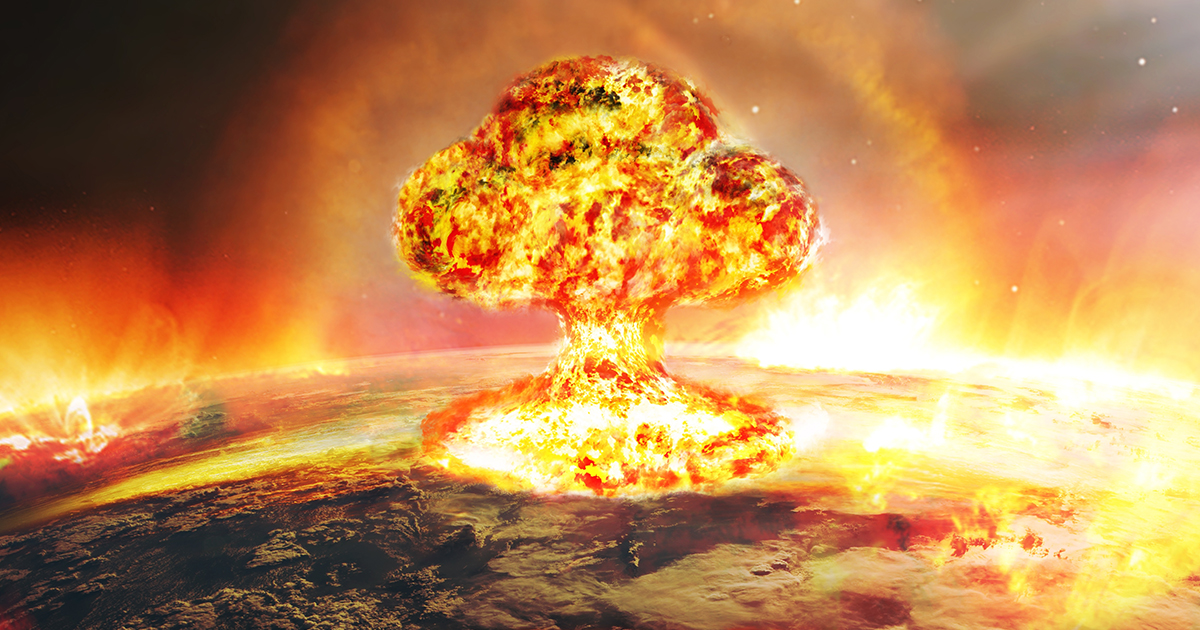
Nearly 70 years ago, a scientist who warned AI was “dangerous” calculated an apocalyptic event in November 2026 – Friday the 13 – a chilling “doomsday” just weeks away.
The extraordinary warning dates back to 1960, when three University of Illinois scientists used centuries of population data to calculate when humanity could reach a breaking point.
Almost 70 years later, their predicted date is almost here, while a warning from one of the researchers about artificial intelligence has given the old study an unsettling new relevance.
That warning comes as AI researchers are making frightening predictions of their own. Earlier in September, Anthropic alignment-science lead Evan Hubinger warned that AI “could kill all humans” within the next decade, while former Anthropic and OpenAI researcher Jacob Coxon said companies developing the technology are “gambling with our lives.”
AI warning in 1960
Heinz von Foerster, who died in 2002, was decades ahead of today’s debate over how humans understand and interact with AI.
During a 1995 interview with Stanford Humanities Review, the Austrian-American scientist warned against believing that machines could “think” like humans, calling the idea of giving them human qualities “dangerous.”
“The anthropomorphization of these machine functions I see insofar as dangerous. Because one may be tempted to believe that when we say, ‘this machine thinks’ we know now how we think, for we know how the machine ‘thinks,’” von Foerster said about AI, describing the tech as “very much motivated and extremely competent.”
More than three decades before that interview, however, von Foerster had put his name to a far more apocalyptic prediction, and this one came with an exact date.
Friday, Nov. 13, 2026
Von Foerster, Patricia M. Mora and Lawrence W. Amiot published their research on Nov. 4, 1960, under the hard-to-miss title, “Doomsday: Friday, 13 November, A.D. 2026.”
Their calculation had nothing to do with a world war triggered by an “unhinged” U.S. president, an asteroid strike or another sudden catastrophe.
Instead, the scientists suggested that, on this day, the “human population will approach infinity if it grows as it has grown in the last two millennia.”
At the time, the world was home to roughly 3 billion people, after the population had risen dramatically during the previous century despite two world wars.
Looking at how quickly those numbers were climbing, the researchers calculated that humanity was heading toward a breaking point, with the population reaching its theoretical limit on that dreaded day in November.
‘Squeezed to death’
They weren’t suggesting billions of people would suddenly appear overnight. Instead, their calculations warned that the rapid growth simply couldn’t continue forever on a planet with limited space and resources.
“From a game-theoretical point of view,” it can be seen “as a single person playing” a “game with nature as its opponent,” the report explained.
And they didn’t soften what they believed could happen when humanity finally reached that limit.
“Our great-great-grandchildren will not starve to death. They will be squeezed to death,” the team of scientists wrote, adding that if explosive population growth continued, “something will happen that will stop this ever-faster race to self-destruction.”
Earth’s ‘terminal stages’
Fortunately, the prediction depended on the population continuing to grow at the same extraordinary pace.
It hasn’t.
Today, the world’s population sits at about 8.3 billion, according to Worldometer, showing a considerable slowdown in the rate of growth since its peak in the 1960s.
That means humanity is no longer following the trajectory that produced von Foerster and his colleagues’ Nov. 13, 2026, mathematical doomsday.
But scientists have calculated a very different timeline for Earth’s future.
In a 2021 study published in Nature Geoscience, researchers from NASA determined the “terminal stages of planetary habitability” could arrive in just over a billion years, when Earth’s oxygen-rich atmosphere is expected to dramatically decline, fundamentally changing the planet’s ability to support complex life.
So, after waiting 66 years for the date to arrive, November 14 might feel just a little more comforting.
What do you think of a warning made more than six decades ago by a scientist who also sounded the alarm over the dangers of AI? Please let us know your thoughts and then share this story to get the conversation started!
Read more:
- ChatGPT CEO Sam Altman reveals the two terrifying ways AI could end “very badly”
- Bill Gates says only 3 jobs are safe from AI amid warning it has “10% chance of killing all humans by next decade”
- AI-generated photo circulates showing Donald Trump and aide Natalie Harp “kissing on golf course”
- AI expert shares terrifying warning how AI could wipe out humanity within 10 years
- At 33, Nick Reiner makes shock demand to his family after avoiding death penalty
- Beloved ’80s sitcom star dies at 85