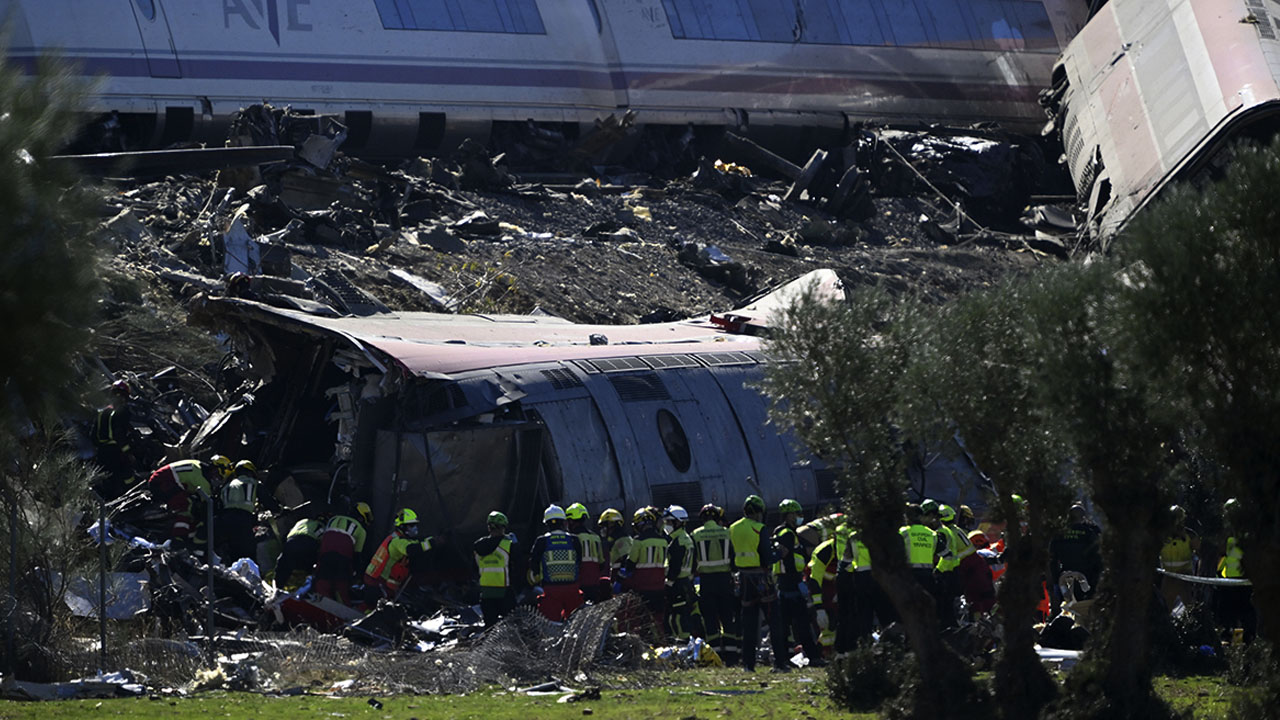
At least 68 people have died after two high-speed trains collided in Spain. The country’s transport minister says the crash came down to an order that never should have been given.
At least 68 people have died after a high-speed train crashed into another train that was standing still on the tracks in Spain. The collision happened on Wednesday, October 28, in the province of Toledo.
Both trains were carrying hundreds of passengers between Madrid and Seville. Survivors have described what the aftermth as “apocalyptic.”
The regional government of Castilla-La Mancha confirmed the death toll and said another 58 people were being treated in hospital. Rescue crews are still searching through the wreckage for survivors and bodies.
The train should never have moved in the first place
Spain’s transport minister, Oscar Puente, has now laid out how the tragedy happened. At around 8:30am, a computer malfunction knocked out the safety system on a 39-mile stretch of the line, making every train on that section stop.
But central command then told one of them, a train run by state-owned operator RENFE, to start moving again, without a speed limit.
At 8:53am, it slammed into a train belonging to the private company IRYO, which was still standing on the tracks. Two of the IRYO train’s cars were knocked off the rails in a rural area between two villages.
Puente called the order “inexplicable.” He said the RENFE train should never have been cleared to move while the stop signal was still on, and that at the very least it should have been told to slow down.
He also made clear the drivers were not to blame. “I am not attributing responsibility to anyone, I am just stating the facts,” he said. It’s not confirmed yet, but Puente said the train may have been doing about 124mph on that part of the line.
Carriages absolutely torn apart
Some carriages were completely destroyed, with other reduced to twisted pieces of metal. Health minister Monica García warned early on that the death toll would be high.
“It was a high-speed impact, so we are expecting this to be a tragedy,” she said and added that rescuers were concentrating on the two most badly damaged cars.
Ignacio Relano was on board the RENFE train. According to Fox News amongst other sources, he told Spanish public broadcaster TVE that he felt the train brake hard just before the crash. “We all felt the train abruptly slowing down and then the impact,” he said and continued:
“The car leaned to one side like it was about to tip over. I hit my nose, everything went flying, luggage, cell phones. Everything shook.”
This is the second deadly high-speed rail disaster to hit Spain this year. In January, the rear of a train traveling from Málaga to Madrid derailed near Adamuz, in Andalusia, and crashed into a train coming the other way. More than 40 people were killed.
Read more: