A 22-year-old mother’s ears wouldn’t pop after a flight, and what doctors eventually found was far more serious than the altitude sickness she was initially told to expect.
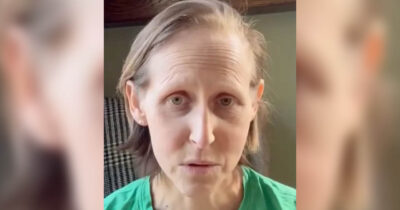
Aida Burkins, a 22-year-old mom of two from Hemet, California, was flying to Chicago in May 2025 and her ears just wouldn’t pop.
Things got worse over the following months: she started bleeding into her throat, a symptom that only became visible when she hinged at the hip. Her hearing also kept getting worse and she lost weight without trying.
Everything sounded muffled, layered under a ringing that wouldn’t stop.
Months of doctors telling her it was nothing serious
Burkins went from doctor to doctor trying to get answers but the diagnosis stayed the same: altitude sickness.
Finally one doctor discovered a mass blocking her Eustachian tube, the small channel connecting the middle ear to the back of the throat and nose. Her adenoids were enlarged and inflamed and had to be removed.
She was referred to an ENT specialist, who flagged the mass as concerning, though initially thought cancer was unlikely given her age.
Finally, the diagnosis that changed everything
While waiting on her first biopsy results, the left side of her throat began to swell, prompting a second biopsy. Her doctor was blunt about how unusual her case was.
“The doctor told me he had never seen anything quite like what I had going on,” Burkins said. “He couldn’t be sure it was cancer, but he said it was very suspicious.”
CT scans revealed the concern was justified, showing lumps throughout her body, including in the lymph nodes near the base of her skull. After surgery, she received the diagnosis: nasopharyngeal carcinoma, a rare cancer affecting the upper throat behind the nose.
It’s uncommon in the US, affecting fewer than one in 100,000 people annually, and is closely linked to the Epstein-Barr virus along with genetic and environmental factors.
Processing the news as a mother
Burkins recalls thinking about her kids when she initially received the diagnosis.
“All I thought about was not being able to see my babies grow up or do the things they want to do in life. It was horrifying.”
Since starting chemotherapy and radiotherapy, Burkins says the tumor has shrunk significantly, and her doctors are optimistic about her chances of becoming cancer-free.
She’s chosen to share her story publicly as a reminder that cancer, as she put it, “doesn’t discriminate,” and can affect anyone, at any age.
READ MORE:
- Six Flags roller coaster shut down following several deaths and brain injuries
- After her death, Donald Trump makes claim about relation to Dolly Parton