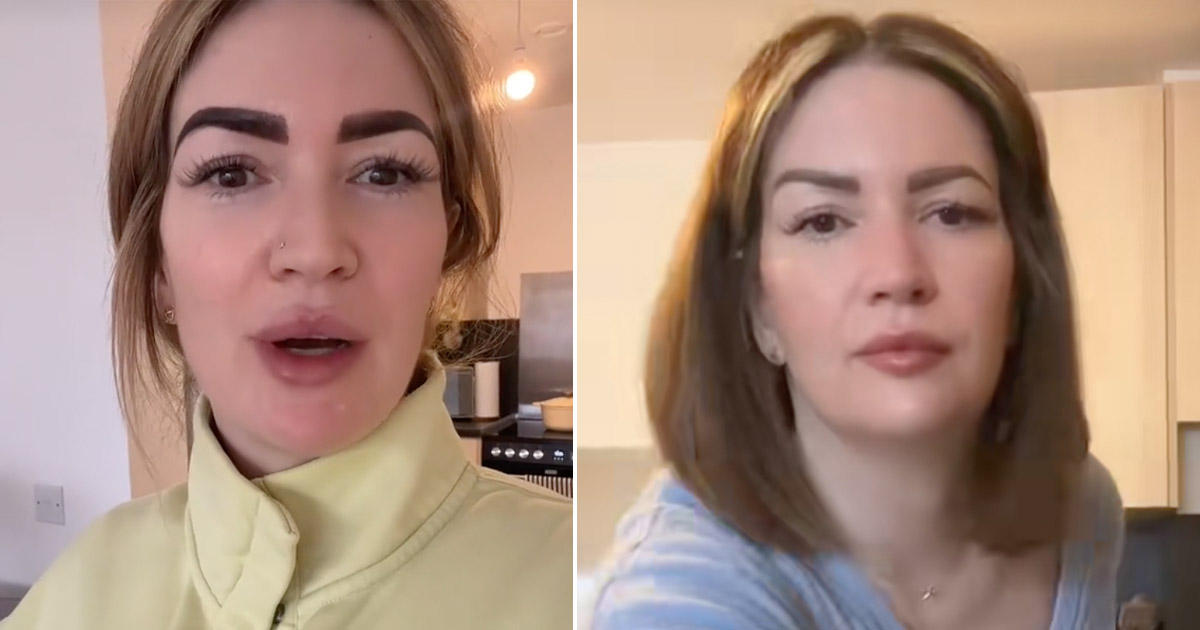
Kimberley Anderson thought she had found a simple explanation for the aches and pain that had been bothering her. Her mattress was old. She was getting older. And she was otherwise living what she considered a healthy lifestyle. But the pain wasn’t coming from her bed.
The 39-year-old mother had already been through breast cancer once. In October 2019, she discovered a lump in her left breast while showering and was diagnosed with stage three breast cancer.
She went through chemotherapy and radiation before undergoing a mastectomy with reconstruction on her left breast.
For a while, Kimberley was able to put cancer behind her. Then, in early 2023, she began feeling unusually exhausted.
The fatigue became so intense that she needed to sleep during the day. She also experienced nausea, a loss of appetite, weight loss and muscle and bone pain.
“I thought I was just getting older, or my mattress was hurting my back. It was an oldish mattress – I did actually go and buy a new mattress,” she said, according to UNILAD.
Early cancer symptoms
Kimberley bought a new mattress in January 2023, but changing her mattress didn’t solve the problem.
“I was thinking ‘it must be me, I’m getting older’, I wasn’t thinking about cancer at all.”
“I was going to the gym – I was living a healthy lifestyle at the time. I just didn’t really think the cancer would come back because I had been living quite healthily.”
Then her symptoms took a frightening turn. In August 2023, Kimberley went to the emergency room after the pain in her neck became so severe that she was struggling to breathe and swallow. Doctors ordered a CT scan, and the results revealed a 5cm tumor in her neck.
Kimberley was diagnosed the following month with stage four metastatic breast cancer. Doctors also discovered that the cancer had spread to her chest wall, ovary, rib and adrenal gland.
“It was an absolute shock because I really had put it [the cancer] behind me. I thought that chapter of my life was closed and I didn’t want to think about it again.”
It spread to her brain
She underwent five rounds of radiation in October 2023 to target the tumor in her neck, followed by 12 rounds of chemotherapy.
In July 2024, Kimberley learned that the cancer had spread to her brain.
She underwent surgery two months later, in September 2024, to remove the brain tumor. She now takes oral chemotherapy tablets every day. There is no cure for her breast cancer, but Kimberley says her cancer is currently stable, with no growth for more than a year.
“The cancer is still present but it’s completely stable, there has been no growth for over a year now. I hope that I stay on this treatment for as long as possible.”
“When this one does stop working, I’ll move on to a different one and I think that will be my last treatment – I think that’s my last option.”
“Do what you need to get seen by proper specialists”
Despite the difficult prognosis, Kimberley refuses to let statistics determine her future.
“The statistics before the cancer moved to my brain was that my prognosis was anything between 10 and 20 years, but once it goes to your brain the statistics say that it drops to between three and five years,” she continued.
“I don’t believe in these statistics, I don’t take any notice of that. Just because it’s three years on the statistics, it doesn’t mean that it’s three years for me. I’m not just a statistic, I’m stronger than a statistic.”
Now, Kimberley is using her experience to encourage other women to pay attention to changes in their bodies.
“We know our bodies better than anyone, including the GP, so don’t let a GP fob you off.”
“Advocate for yourself, push past the primary care barrier, do what you need to get seen by proper specialists.”
What to look out for
According to Mayo Clinic, some of the symptoms of breast cancer might include:
- A breast lump or thickened area of skin that feels different from the surrounding tissue.
- A nipple that looks flattened or turns inward.
- Changes in the color of the breast skin. In people with white skin, the breast may look pink or red. In people with brown and black skin, the breast may look darker than other areas on the chest or it may look red, purple or brown.
- Change in the size, shape or appearance of a breast.
- Changes to the skin over the breast, such as dimpling or skin that looks like an orange peel.
- Peeling, scaling, crusting or flaking of the skin on the breast.
Kimberley hopes her story will remind other women not to dismiss symptoms that don’t seem immediately alarming, even when they appear to have an ordinary explanation.
Read more: