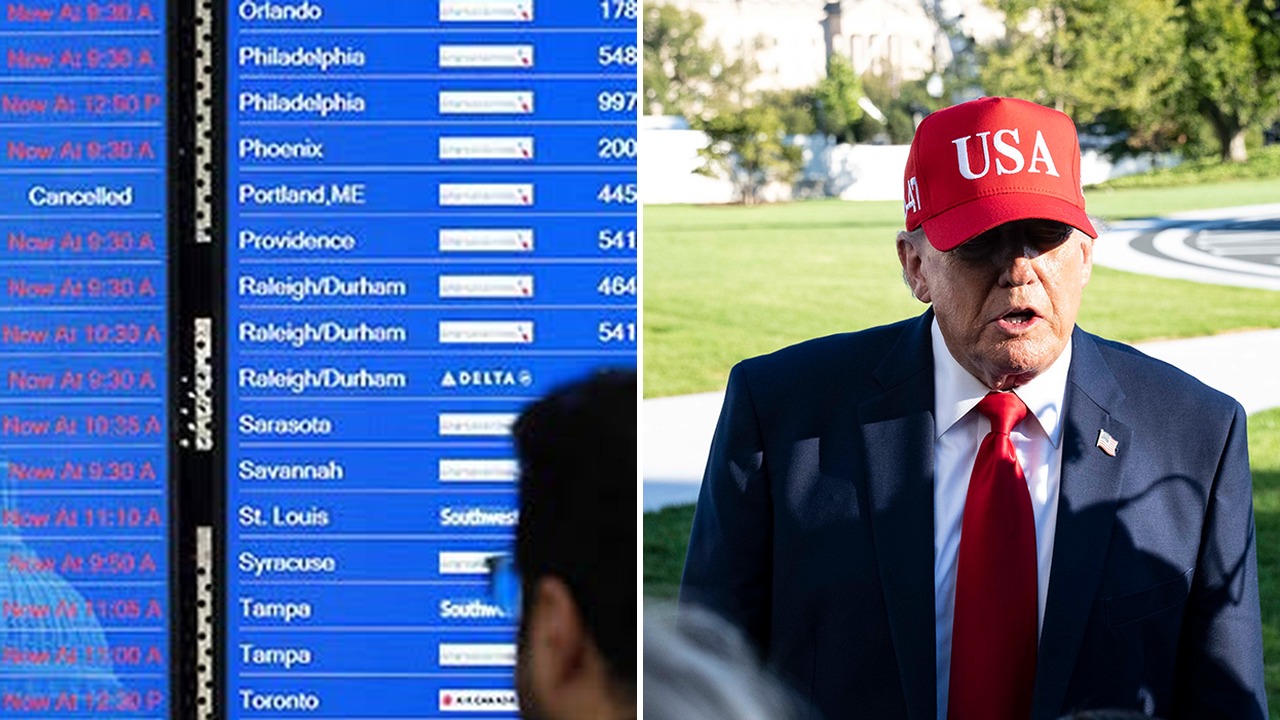
More than 3,500 planes were in the air when America’s air traffic control system started to fail. Now officials have revealed what went wrong, and how much fixing it might end up costing.
Thousands of flights across the US were disrupted on Friday, November 13, after a failure in the country’s air traffic control system which forced a nationwide ground stop. According to the Department of Transportation, the problem was caused by the aging technology used by the Federal Aviation Administration (FAA), not a cyberattack.
Transportation Secretary Sean Duffy and Homeland Security Secretary Markwayne Mullin spoke about the incident at a White House briefing on Friday evening.
Thousands of planes were in the air
Duffy said the trouble started at 3:36 p.m. ET, when instability was detected in radar and communications systems at air traffic control centers and approach control facilities across the country. The FAA then ordered all departures to stop. At the time, more than 3,500 planes were in the air.
Officials worked to bring them down safely using standard procedures. When Duffy last checked, fewer than 400 aircraft were still in the sky. All of this was done to ensure the safety of passengers.
He also underlined that the FAA never completely lost its radar or communications, but the systems were still unstable enough that officials decided that grounding flights nationwide was the right choice. The ground stop lasted over four hours.
Copper lines from the 1980s
The incident highlights how outdated America’s air traffic control system is, with some of the technology dating back all the way to the 1980s according to Duffy.
He explained that the system still relies on old copper telecom lines, along with aging switches and routers. These parts then became overloaded with data, which caused the instability. According to Duffy, some older switches have already been swapped for newer internet-based ones, which kept working during the outage.
A $50 billion request to patch the ‘national emergency’
Mullin addressed rumors that someone may have attacked the system on purpose. He said officials had seen “zero evidence” of a cyberattack or an AI-related attack. The failure appeared to be mechanical, he said, though the investigation is still ongoing.
The incident certainly adds pressure on Congress to pay for an up-to-date system. $12.5 billion that came through the One Big Beautiful Bill is already being used to start replacing outdated equipment, but according to Duffy it won’t be enough. He called for an extra $50 billion in emergency funding, described the situation as a national emergency and urged lawmakers from both parties to back it.
The administration wants Congress to fund a completely new network instead of more patch-up repairs.
Read more: