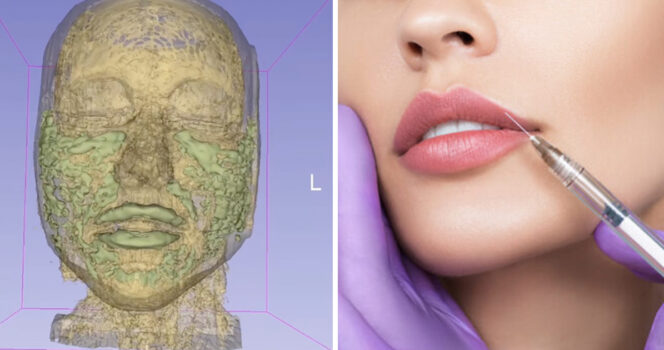
A shocking MRI scan suggests facial fillers may create the opposite result for those chasing youth, prompting a Beverly Hills plastic surgeon to warn, “you cannot fill your face to youth.”
Non-surgical cosmetic enhancements have surged in popularity over the past decade, largely because they promise visible results without the recovery time associated with traditional procedures.
Injectable fillers, particularly those made from hyaluronic acid (HA), are commonly used to soften lines, restore lost volume, and shape facial features with subtle precision. Because the treatments are often marketed as temporary, many patients assume the effects will fade naturally over time.
MRI reveals truth
But according to Dr. Kami Parsa, an oculoplastic and reconstructive surgeon based in Beverly Hills, the long-term reality may be more complicated.
In July 2024, Parsa shared a TikTok video that quickly drew global attention, generating more than 12.8 million views.
The clip features MRI imaging of a 33-year-old patient who had received approximately 12 syringes of HA filler over a six-year period, offering a rare glimpse of how these substances can appear beneath the surface years later.
The imaging revealed a surprising detail: the volume detected in the patient’s face was significantly greater than the amount originally injected.
HA fillers ‘log water’
In the video, highlighted areas show clusters of filler material still present long after treatment. The scan indicates that hyaluronic acid’s ability to attract and retain water may contribute to an increase in volume over time, rather than the gradual disappearance many people anticipate.
“What’s interesting here is that when we did volumetric analysis, that means when we measured the amount of filler, the amount of volume that was there, it ended up being close to 28cc, which is more than twice the amount of filler than was injected,” Parsa said in the clip.
“What this shows us is that hyaluronic acid fillers are hydrophilic – that means they log water, and they also cause tissue expansion.”
Although HA fillers are often described as dissolving within six months to two years, Parsa suggests traces can remain beneath the skin for much longer, particularly when injections are repeated regularly. Over time, retained filler combined with water absorption may create a buildup effect that alters the natural contours of the face.
‘Lips look like sausages’
When filler accumulates beyond subtle enhancement, it can create an overly rounded or bloated appearance sometimes referred to as “overfilled syndrome,” or “pillow face.” Rather than restoring youthful proportions, excessive volume can blur facial definition and produce a noticeably artificial look.
“How do you know if you are starting to get pillow face – you are starting to resemble a chipmunk when it comes to your cheeks, you have a chin boner, or your lips look like sausages,” explains Brittany Wilson, an aesthetic nurse practitioner and founder of RAE Aesthetic. “My best tip to avoid falling victim to the pillow face epidemic – find a reputable injector who says NO to too much filler!”
How pillow face develops
According to experts, the overfilled look is not an overnight issue. Instead, it often results from:
- Layering fillers: Repeated injections without allowing previous fillers to dissolve can lead to filler accumulation.
- Overcorrection: Adding too much volume in one session or focusing too heavily on certain areas of the face.
- Skin stretching: The filler’s weight can gradually stretch the skin, making the face look unnaturally round or puffy.
“We feel that, sometimes, hyaluronic acid fillers have been overused for many years. We felt it’s important to share our findings,” Parsa told Newsweek of the long-term sustainability and safety of frequent filler applications. “We hope that people will learn that less is more when it comes to the HA filler.”
‘We’re beautiful without surgery’
The video has triggered strong reactions online, with many viewers expressing surprise at how long filler may remain in the body.
“FINALLY THIS IS BEING TALKED ABOUT. The mass production and insane usage without WARNING. I need to know more,” shares one user in the comment section of the clip.
Another netizen wrote, “I got lip filler once and I’m convinced they are above and below my lips and will never go away.”
Others say the footage reinforced their decision to avoid cosmetic injectables altogether. “Love this visual thank you! I keep my face natural and let it age. I prefer that to regretting [alterations] and possible health issues,” one person shared.
Another added: “So sad. We’re beautiful without surgery or fillers.”
Does this information make you think twice about fillers? Share your thoughts in the comments – and pass this story along to keep the conversation going!
READ MORE