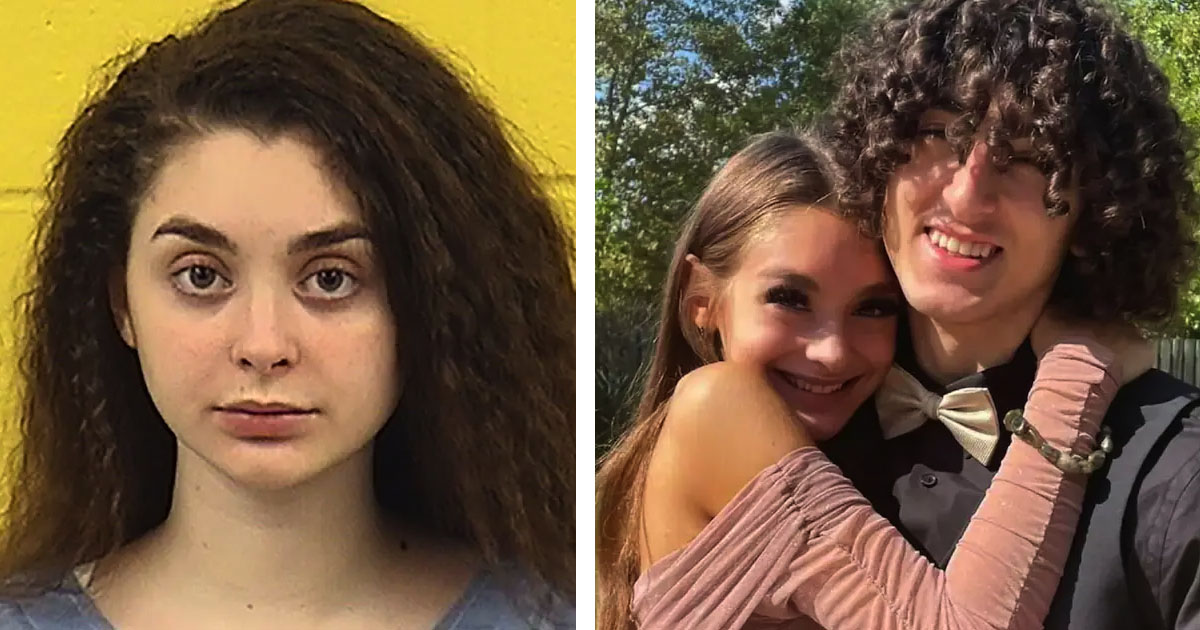
Before a judge convicted her of murder, Mackenzie Shirilla claimed she blacked out behind the wheel. Now, newly surfaced text messages reveal she was “scared” her blackout episodes were getting worse before the crash that killed two young men.
Keep reading to know more.
Days before her 18th birthday, Mackenzie Shirilla slammed her Toyota Camry into a brick wall at nearly 100 mph, killing her boyfriend, 20-year-old Dominic Russo, and their friend, 19-year-old Davion Flanagan.
Prosecutors argued the collision was no accident. They claimed Shirilla deliberately accelerated toward the wall after a turbulent period in her relationship with Russo, pointing to alleged threats, text messages and videos recovered from his phone that reportedly captured explosive arguments between the couple.
Throughout the trial, Shirilla, who was tried as an adult, maintained she could not remember the crash and denied deliberately causing it.
Her defense team argued she suffered from Postural Orthostatic Tachycardia Syndrome (POTS), while both Shirilla and her mother pointed to a possible medical episode as the explanation behind the deadly crash.
“I always tell everybody that she has POTS,” Natalie Shirilla said in court. “POTS stands for Postural Orthostatic Tachycardia Syndrome. It’s a blood pressure disorder. You can either get dizzy, lightheadedness, you can black out.”
“And so, you were aware of these POTS incidents, yet you still went to the DMV and said, ‘Give my daughter a driver’s license,” the prosecutor said to the mother when she was on the witness stand.
According to the true-crime doc The Crash, no medical records or expert testimony confirming a diagnosis were ever presented during the trial.
Surveillance footage also proved otherwise – the teen appeared to be alert and in control as she navigated winding roads. And data recovered from the vehicle demonstrated that the accelerator remained pressed until impact.
After reviewing the evidence, Judge Nancy Russo rejected the blackout defense and sided with prosecutors.
“The [crash] video clearly shows the purpose and intent of the defendant,” the judge said, according to CBS affiliate 19 News.
During sentencing, Russo described Shirilla as someone who transformed from an ordinary teenager into “literal hell on wheels” before carrying out a mission of “death and destruction.”
Then came the line that quickly dominated headlines across the country: “This was not reckless driving. This was murder,” Russo said, explaining that Shirilla’s actions were “controlled, methodical, deliberate, intentional and purposeful.”
Now, 21, the woman – who’s proudly embraced her prison nickname “Shirilla the Killa” – is serving two concurrent sentences of 15 years to life at the Ohio Reformatory for Women and could become eligible for parole in 2037.
Adding a new layer of speculation, newly released text messages obtained by People suggest that she experienced blackouts long before the fatal crash.
In one message sent from Shirilla to Russo in 2020, Shirilla wrote: “I had a [really] bad blackout today fr. [for real]”
Less than a month before the crash, on July 2, 2022, she again described experiencing what she called “probably the worst blackout like pain level I’ve had.”
After telling her boyfriend she was “scared it’s just gonna get worse,” Russo responded by suggesting a vitamin deficiency could be affecting blood flow to her brain, according to TMZ.
The conversation quickly turned tense, with Shirilla allegedly telling him: “Keep treating me like this see where that gets you.”
The texts emerged as millions of viewers revisited the case through Netflix’s The Crash, bringing renewed scrutiny to Shirilla’s long-standing claim that she blacked out before impact.
In her first-ever interview, Shirilla was asked directly about one of the central questions in the case.
“How does a medical emergency account for the control of the car?” the killer was asked.
“I remember turning on the street and then I’m waking up in the hospital the next day and my whole life is shattered,” Shirilla says.
“I’m unsure because I have no recollection of that morning, but I know nothing about it was intentional because that’s not my character,” she insisted. “I just know myself, and I know I’m not a monster.”
The legal battle is far from over.
On April 27, 2026, People reports that Shirilla’s attorneys filed an appeal with the Ohio Supreme Court, arguing that “there is medical evidence” she “suffered from a pre-existing medical condition that could have caused her to black out while driving.”
The filing also claims her trial attorney failed to properly investigate that possibility and did not seek expert testimony that could have supported the defense.
The Ohio Supreme Court has not yet announced whether it will hear the appeal.
What do you think of Mackenzie Shirilla and her blackout claims? Please let us know your thoughts and then share this story so we can hear from others!
READ MORE
- Mackenzie Shirilla’s ex from prison reveals “sick” plan after release
- Mackenzie Shirilla’s dad breaks silence and makes claim he says ‘will get him in trouble’