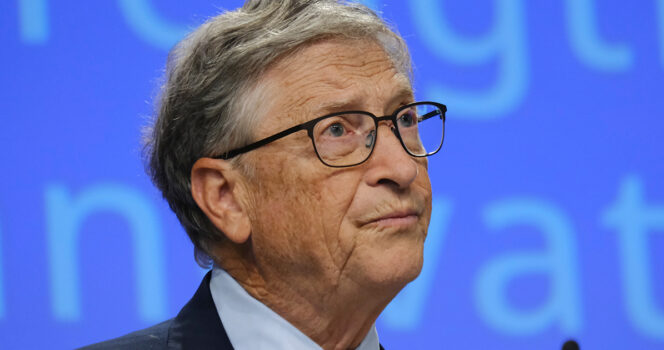
With artificial intelligence threatening to upend millions of jobs, Bill Gates has identified three careers he believes will survive the AI revolution – and now, experts say a fourth deserves a place on the list.
For years, Bill Gates has warned that artificial intelligence (AI) won’t simply change the way people work; it could fundamentally reshape the workforce itself.
Speaking on The Tonight Show with Jimmy Fallon, Gates pointed out that what we currently consider valuable human expertise – whether it’s a “great doctor” or a “great teacher” – still matters because it’s “rare.”
But “with AI, over the next decade, that will become free, commonplace – great medical advice, great tutoring,” he told Fallon.
In other words, if AI replaces humans “for most things,” the very idea of expertise could shift into something widely available, instantly accessible, and no longer tied to a single human professional.
But, “there will be some things we reserve for ourselves,” Gates said, adding people will never see machines playing baseball. “But in terms of making things and moving things and growing food, over time those will be basically solved problems.”
‘Free intelligence’
It’s a future Gates, 70, has described as the arrival of “free intelligence” – one he believes is approaching far faster than many people realize.
During a conversation with Harvard professor Arthur Brooks, Gates – who dropped out of Harvard in 1975 to “focus on building a new kind of software company” – acknowledged both the extraordinary potential and the uncertainty surrounding AI’s rapid development.
“It’s very profound and even a little bit scary – because it’s happening very quickly, and there is no upper bound,” said Gates, who pioneered the revolution of microcomputers.
Looking further ahead, Gates suggested AI could eventually outperform people across a wide range of fields.
“The machine will probably be superior to humans – because the breadth of knowledge that you need to make some of these decisions really goes beyond individual human cognition,” he added.
Dozens of roles now at risk
His warnings come as AI is already reshaping workplaces around the world.
A recent Microsoft study identified dozens of occupations that are increasingly exposed to AI, with roles including administrative work, customer service, translation, concierge and travel clerks among those considered most vulnerable as businesses adopt the technology.
While experts continue to debate exactly how many jobs will disappear, many believe the biggest change won’t necessarily come through mass unemployment but from AI taking over routine tasks that once required human workers.
Three jobs safe from extinction
Despite his warning that AI will transform countless careers, Gates doesn’t believe every profession is headed for extinction.
In an interview with The Economic Times, Gates explained that the jobs most likely to endure are those that demand original thinking, adaptability and judgment beyond what AI can currently deliver.
Software development: Even though AI can now write snippets of code and assist with programming tasks, Gates said that it still depends on skilled developers to oversee complex projects, fix errors and improve the very systems driving AI. As the technology evolves, human programmers will continue guiding that process rather than watching from the sidelines.
Energy industry: From balancing electricity grids to planning long-term infrastructure and responding to unpredictable global events, the field presents challenges that can’t simply be solved by processing data. Gates said he believes AI will become an increasingly valuable assistant, but experienced professionals will still be needed to weigh competing priorities and make difficult decisions.
Biology: medical research is another area he expects to remain firmly rooted in human expertise. While AI can accelerate research by identifying patterns and analyzing huge volumes of information, Gates argues that major breakthroughs rarely happen through data alone. Asking bold questions, challenging existing ideas and making unexpected connections are all qualities he believes continue to set human researchers apart.
Human qualities machines can’t replicate
Beyond Gates’ three professions, many experts believe another group of careers is also well positioned to withstand the rise of AI.
Careers driven by creativity, emotional intelligence and ethical decision-making – from therapists and artists to legal professionals – still require a level of human understanding that AI has yet to achieve.
The same is true for careers built around personal connection, including caregiving and education, where technology is more likely to become a tool than a replacement.
What do you think about AI’s position in the workforce? Please share your thoughts with us and then pass this story along so we can hear from others!
READ MORE
- Barack Obama reveals what happens when Trump is actually in the room with him
- Elon Musk makes chilling WW3 prediction – and it’s worse than we thought