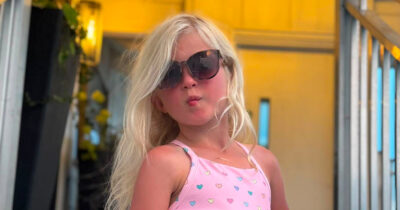
A Texas mother was left frustrated after strangers on TikTok started playing doctor and diagnosing her 4-year-old daughter based on nothing more than a couple of photos.
Keep reading to learn more.
Kiely Branch, a mother of four who is currently expecting her fifth child, said viewers became increasingly aggressive after deciding that her daughter’s dark, full eyebrows were a sign of a rare genetic disorder.
What initially seemed like an ordinary family post suddenly turned into a wave of unsolicited medical advice, with some people even accusing Branch of neglecting her daughter by not taking her to a doctor.
“Imagine walking into the pediatrician’s office and saying, ‘Hi, TikTok told me my daughter has a genetic disorder because of her eyebrows,’” she joked.
The mother was shocked when a normal family photo suddenly went viral
Branch regularly shares snippets of her busy family life online. With four children under five and another baby on the way, she describes her home as anything but boring.
Her Facebook and TikTok followers have become accustomed to seeing the everyday chaos that comes with raising so many young children.
But one post featuring her oldest daughter unexpectedly took off.
At first, Branch said the post was barely getting any attention. She even considered deleting it because the number of views was so low.
“Then I woke up the next morning and it had completely taken off,” she told Newsweek.
The reason for the sudden attention wasn’t exactly what she had hoped for.
Instead of compliments about her daughter, Branch found hundreds of people discussing the little girl’s appearance and suggesting that something might be medically wrong with her.
Viewers claimed the girl’s eyebrows were a sign of Sanfilippo syndrome
According to Branch, several people told her she should have her daughter checked for Sanfilippo syndrome, a group of rare genetic disorders that affect the central nervous system and progressively worsen over time.
Their reasoning?
Her eyebrows.
“A surprising number of people were telling me that I needed to have my daughter checked for a particular genetic condition because of her eyebrows,” Branch said.
Some commenters reportedly went even further, telling her to take her daughter to a pediatrician “before it was too late.”
That was when the mother said the comments stopped being amusing.
“As the comments became more aggressive, especially the ones implying that I was neglecting my daughter by not taking her to a doctor, I did get frustrated,” she explained.
Branch said she found it particularly bizarre that strangers were making medical assumptions about a child they had never met and had only seen in photographs.
Branch said her daughter has always had naturally thick eyebrows
The mother acknowledged that her daughter’s eyebrows are dark and full, but said there is nothing unusual about that in their family.
Both she and the girl’s father naturally have thick eyebrows, with Branch even joking that they both have “unibrows.”
“Her father and I joke that our kids were genetically destined to have thick eyebrows and potentially unibrows if we don’t groom them,” she said.
For Branch, the situation was a reminder of how quickly people online can jump from noticing one physical feature to making an entire diagnosis.
“It has been really interesting, and sometimes hilarious, watching the internet try to figure out a child they’ve never met from two photographs,” she said.
The mom said her daughter wasn’t experiencing the other symptoms people were mentioning
Branch also pushed back against the idea that her daughter’s eyebrows were somehow evidence of a broader health problem.
She said the 4-year-old has never had an ear infection, does not have the gastrointestinal issues commenters were discussing, sleeps extremely well, and has not had concerns about her development or head circumference raised by her pediatrician or other medical professionals.
In other words, according to her mother, there was no reason for strangers online to assume that a genetic disorder was being overlooked.
Branch said the whole experience was “pretty wild,” particularly because some commenters seemed convinced they knew more about her daughter’s health than the people actually caring for her.
The incident also highlights a bigger problem with social media: a photograph can show what someone looks like, but it cannot provide the medical history needed to diagnose them.
“She’s so adorable. I hope she’s okay,” one commenter wrote
Despite the criticism and unsolicited medical advice, not everyone reacted negatively to the little girl’s photos.
Some commenters simply thought she was adorable and expressed concern for her wellbeing rather than trying to diagnose her.
For Branch, however, the experience was a strange reminder that posting an innocent family photo online can sometimes invite far more opinions than a parent ever asked for.
Share this with others who like to keep up with the latest news stories.
READ MORE