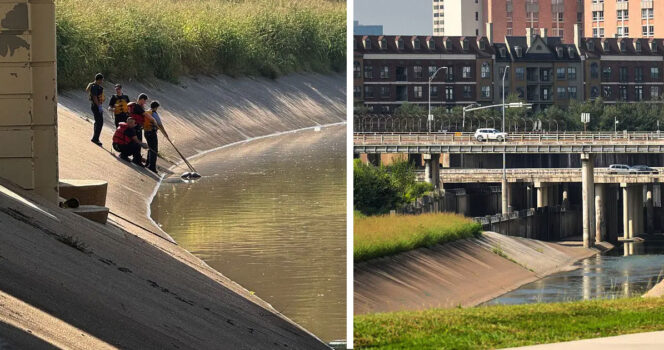
Three bodies have been found in Houston’s bayous in less than two weeks. The discoveries have reignited online speculation about a serial killer.
Houston police are investigating how three bodies turned up in the city’s waterways within a two-week span.
This is unfortunately adding to a pattern that’s had people talking since 2025, when 34 bodies were pulled from the city’s bayous over the course of the year.
According to the Harris County Medical Examiner’s Office, at least 201 bodies have been recovered from Houston’s bayous between 2017 and late November 2025.
The three latest discoveries
The first of the latest discoveries came on July 29, when a lawn care crew found a woman’s body near Sims Bayou. She was later identified as 33-year-old Yvonne Lopez. Her cause of death hasn’t been confirmed yet, but investigators determined her body had been partially burned.
Less than two weeks later, on August 10, a man’s body was found floating in Brays Bayou. His identity and cause of death remain unconfirmed.
The very next day, another man’s body was discovered along Buffalo Bayou, in an advanced state of decomposition with no obvious signs of trauma.
Despite the reassurances, the numbers raise questions
Officials have repeatedly pushed back on serial killer theories, both now and after last year’s cases. But the explanations they’ve given don’t fully add up against their own numbers.
Harris County District Attorney Sean Teare has been firm in rejecting the serial killer theory, saying there is nothing pointing to one person being responsible since the causes of death vary.
Houston Mayor John Whitmire addressed the fears back in September 2025, explaining that many of the deaths are tied to the city’s homeless population. He pointed out that when someone without stable housing dies of an overdose, or lack of medical care, there’s often no one to formally handle their remains, and many end up in the bayou instead.
That explains how a body might end up in the water, but not what killed them in the first place.
Records show causes ranging from accidents and overdoses to homicides and blunt force trauma, the latter two together making up more than 40 percent of cases. That’s a striking number, since it means a huge share of these deaths weren’t accidental at all.
Texas State University professor Kim Rossmo, who studies patterns in serial crimes, argued that the pattern doesn’t point to a serial killer, since drowning is rarely how serial killers operate. “We don’t have a serial killer, but we do have a drowning problem,” he said.
But if 40 percent of cases involve homicide or blunt force trauma, “drowning problem” doesn’t quite capture what’s actually happening. Many of these people weren’t drowning victims at all.
READ MORE:
- Ivanka Trump brutally slammed over words about Dolly Parton after death
- New details emerge about Dolly Parton’s secret hospital visit just days before her death