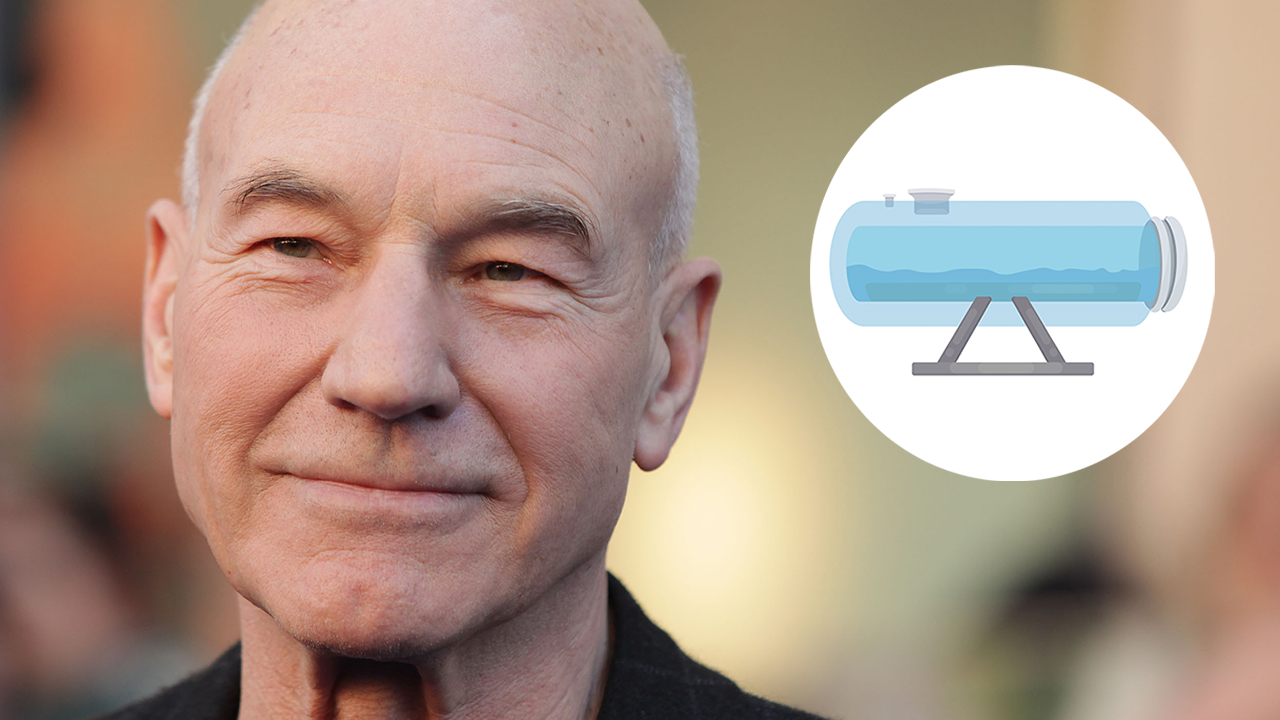
Beloved Star Trek actor Patrick Stewart passed away in late October. His death certificate stated he died from Alzheimer’s disease and Lewy body dementia. However, another detail caught many people’s attention. It stated that Stewart’s remains underwent alkaline hydrolysis, also known as water cremation. But what is water cremation really? Here’s all you need to know about this cremation method, said to be very eco-friendly, and what really happens to the body.
Patrick Stewart’s passing at 86 left many fans heartbroken. The actor, best known as Captain Jean-Luc Picard in Star Trek, was a favorite of many, not only because of the legendary series, but also because Stewart was a well-known supporter of LGBTQ+ rights.
Moreover, his friendship with fellow actor Sir Ian McKellen was particularly famous. The actor, who died at the age of 86 on October 28, passed away after a battle with Alzheimer’s disease and Lewy body dementia.
As reported by TMZ in early November, his death certificate revealed more about his final days, including the method chosen to handle his remains. According to documents obtained by the news outlet, Stewart’s cause of death was listed as cardiopulmonary arrest and a neurocognitive disorder with Lewy bodies.
He was surrounded by his beloved wife, Sunny, along with family and friends. In a touching statement, his family described his final journey as a “brief and poignant journey” with Alzheimer’s disease and Lewy body dementia.
“He has been held in the warm embrace of family and friends, surrounded by live music, prayer, tears, laughter,” the statement read.
But another detail in the death certificate has also attracted attention. According to TMZ, Stewart’s remains underwent alkaline hydrolysis, also known as water cremation, on November 3.
Patrick Stewart’s water cremation explained: How the unusual process works
But what exactly is water cremation, and what happens to a person’s body during the procedure?
The method, also known as alkaline hydrolysis, has been attracting attention as an alternative to traditional cremation. It is also often described as a more environmentally friendly option.
And while the name might sound unusual, the science behind it is quite straightforward. Let’s take a closer look.
The Cremation Association of North America describes the process on its website as “using water, alkaline chemicals, heat, and sometimes pressure and agitation to accelerate natural decomposition, leaving bone fragments and a neutral liquid called effluent.”
The organization further wrote that “the decomposition that occurs in alkaline hydrolysis is the same as that which occurs during burial, just sped up dramatically by the chemicals.”
“The contents may be subjected to heat (199 to 302 degrees Fahrenheit), pressure, and/or agitation (varying with equipment) to ensure proper cremation. This process may take three to sixteen hours depending on equipment and body mass,” according to the Cremation Association of North America.
Eco-friendly way of cremation
It takes between three and 16 hours, depending on the equipment and the person’s body mass. At the end of the process, only bone fragments and a sterile liquid remain. The bone fragments are dried and reduced to a fine powder before being returned to the family, much like ashes after traditional cremation.
The association also explains that water cremation uses significantly less fuel and has a lower overall carbon footprint than both traditional cremation and burial. Some people also choose it because they see it as a gentler alternative to fire-based cremation.
“The process is more environmentally friendly. It uses significantly less fuel and has an overall lower carbon footprint than both traditional cremation and burial,” it reads.
So can anyone go through with being water cremated? Well, not quite, as it depends on where you do it.
Where water cremation is legal
Per the Cremation Association of America, water cremation is currently legal in 26 states. Those are: Alabama, Arizona, California, Colorado, Connecticut, Florida, Georgia, Hawaii, Idaho, Illinois, Kansas, Maine, Maryland, Minnesota, Missouri, Nevada, North Carolina, Oklahoma, Oregon, South Carolina, Tennessee, Utah, Vermont, Washington, West Virginia, and Wyoming. (as of March 2026)
Moreover, in Canada, it’s legal in Manitoba, Newfoundland/Labrador, the Northwest Territories, Ontario, Quebec, and Saskatchewan.
Rest in peace, Patrick Stewart. What’s your opinion on water cremation? Is it something you’d consider, or would you rather be buried in a coffin? Please share your thoughts in the comment section!
Read more: