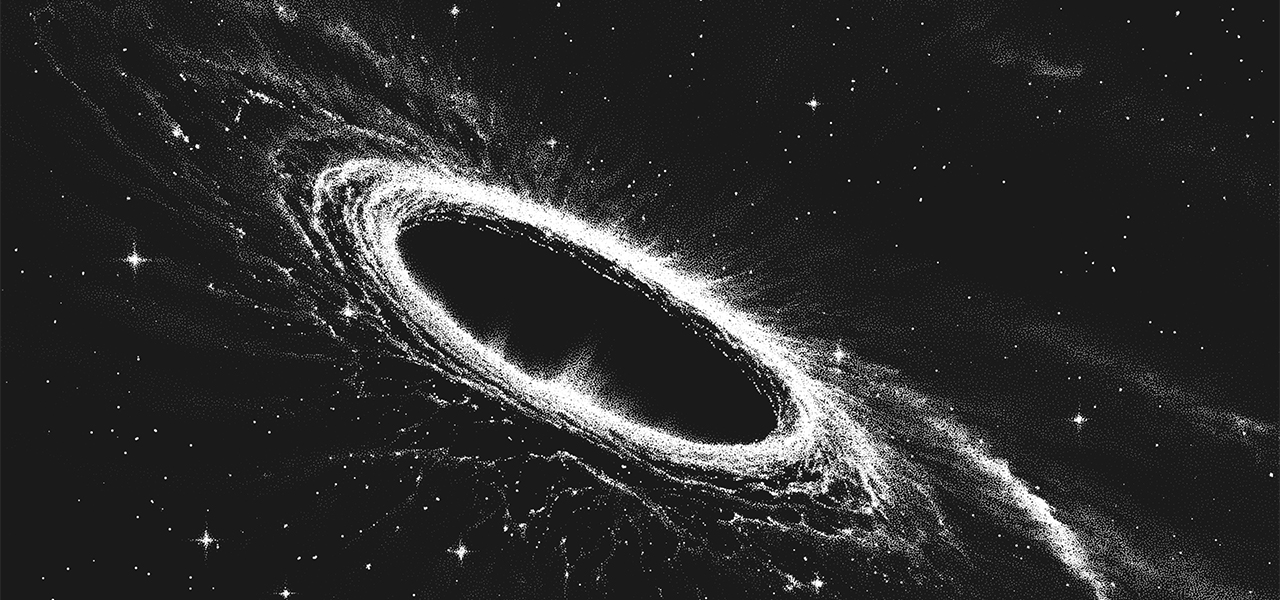
A simulation has revealed what would happen to your body if you fell into a black hole, including the terrifying process known as ‘spaghettification’.
There is something particularly unsettling about black holes. These mysterious cosmic objects are capable of trapping anything that gets too close, creating an environment where even our understanding of time begins to break down.
Although they cannot be seen directly, black holes have an incredibly powerful gravitational pull, so strong that not even light can escape once it crosses a certain point.
What happens if you fall into a black hole?
A video created by Zack D. Films has illustrated what could happen to someone who falls into one of these enormous cosmic objects.
The animation shows how the immense gravitational forces would gradually stretch a person’s body in a process known as spaghettification.
Explaining how it works, he said the gravitational pull ‘would stretch you out’.
‘As you get closer, the gravity at your feet would be much stronger than at your head, pulling you longer and thinner. Eventually, you’d pass the Event Horizon at this point, time would appear to slow down for an outside observer, but for you, time might seem to speed up,’ he explained.
‘Finally, you’d be crushed by the immense gravity merging with the singularity at the black hole’s center, lost forever in its depths,’ he added.
How are black holes formed?
According to BBC Earth, black holes can form from the extremely dense cores left behind when massive stars reach the end of their lives.
When a dying star’s core contains more than roughly three times the mass of our Sun, its gravitational pull becomes so powerful that it can overcome the forces holding it up, causing the core to collapse in on itself.
Astronomers believe that most large galaxies, including our own Milky Way, contain a black hole at their centre.
Scientists generally classify black holes into three main categories, depending on their size and mass.
The smallest are known as stellar-mass black holes, which typically have masses ranging from a few times to around 100 times that of the Sun. These are formed when massive stars collapse at the end of their lives.
Next are intermediate-mass black holes, which sit between stellar-mass black holes and their much larger supermassive counterparts.
The largest are known as supermassive black holes, which can contain millions or even billions of times the mass of our Sun. Scientists believe they grow to such enormous sizes through processes including consuming surrounding matter and merging with other black holes.
Share this with others who enjoy interesting science stories and shocking facts.
Read more: