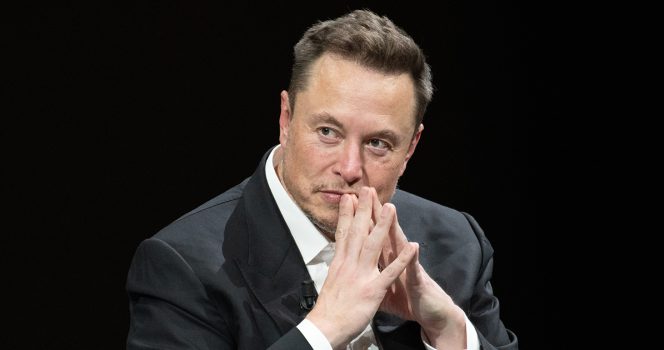
Elon Musk has issued a shocking warning about the future of artificial intelligence, claiming humanity may have only months to prevent a technological catastrophe that could push critical infrastructure off the planet.
Speaking on a recent podcast, Elon Musk said Earth is rapidly approaching its limits when it comes to powering the explosive growth of artificial intelligence.
According to the billionaire entrepreneur, unless AI infrastructure begins moving into space, the planet risks becoming technologically obsolete within just a few years.
The warning comes as AI development accelerates at a pace that is already straining global power grids. Musk argued that while AI is often discussed in terms of software and algorithms, the real constraint is far more basic: electricity.
“All of the United States currently uses only about half a terawatt of power on average,” Musk told Dwarkesh Patel in the Feb. 5 episode of the Cheeky Pint podcast.
“Imagine trying to build enough power plants to double that. People don’t realise how hard that actually is.”
‘Less than 36 months’
His concerns, he explained, center on the difficulty of scaling power generation quickly enough to support increasingly energy-hungry AI systems.
According to Musk, Earth may have only months left to keep pace with AI’s rapid expansion. He predicted that space will soon become the cheapest and most practical location to deploy large-scale AI infrastructure.
“My prediction is that by far the cheapest place to put AI will be space in 36 months or less, maybe 30 months,” he said. “Less than 36 months, mark my words.”
Musk, whose SpaceX is already working on a Mars colonization program, explained that current discussions around AI growth often underestimate the sheer physical demands of running advanced systems. Massive data centers, specialized hardware and cooling systems all require enormous and continuous energy supplies, something he believes Earth cannot expand fast enough.
Solar-powered AI
However, Musk argued that space offers access to infinite solar energy.
Solar panels placed in orbit receive constant sunlight and are not affected by weather, nighttime cycles or atmospheric interference.
The Tesla CEO said that solar panels in space can generate roughly five times as much power as those on Earth. When paired with falling launch costs, the economics begin to favor off-planet infrastructure – especially when battery storage is no longer required.
“Solar cells are already very cheap, around 25 to 30 cents a watt in China,” Musk said. “Put them in space and it’s effectively 10 times cheaper because you don’t need batteries. Once launch costs drop, space becomes the most scalable place to generate AI, and it’s not even close.”
Energy storage, Musk noted, is one of the most expensive and limiting aspects of renewable power on Earth. In orbit, where solar exposure is nearly constant, AI systems could operate without relying on massive battery installations, further reducing costs and complexity.
Harness sun
Musk, who in 2023 founded xAI, framed the issue in existential terms, suggesting that Earth’s inability to scale power infrastructure quickly enough could leave humanity technologically stranded while AI development continues elsewhere.
“You start thinking in terms of what percentage of the sun’s power you’re harnessing,” he said. “Then you realize you have to go to space. You can’t scale very much on Earth.”
Solar-powered data center
Scientific American reported that on Jan. 30, 2026, Musk’s filed plans with U.S. regulators to deploy up to one million satellites to create massive solar-powered data centers in orbit, enabling expanded use of artificial intelligence and chatbots without straining power grids or driving up electricity costs.
Roughly 15,000 satellites orbit Earth today, including more than 9,600 active Starlink satellites – all owned by Musk’s SpaceX. A one-million-satellite data center network would be unprecedented in scale.
Musk’s warning adds to growing concerns among experts about AI’s environmental and infrastructural footprint. As data centers multiply worldwide, their energy consumption has become a major issue for governments and utilities already struggling to meet climate and demand targets.
What do you think of Musk’s warning? Please let us know your thoughts and then share this story so we can hear from others!
READ MORE
- Elon Musk’s daughter breaks silence after he’s named in Epstein files – confirms rumors
- All the latest celebrities named in millions of new Epstein files released