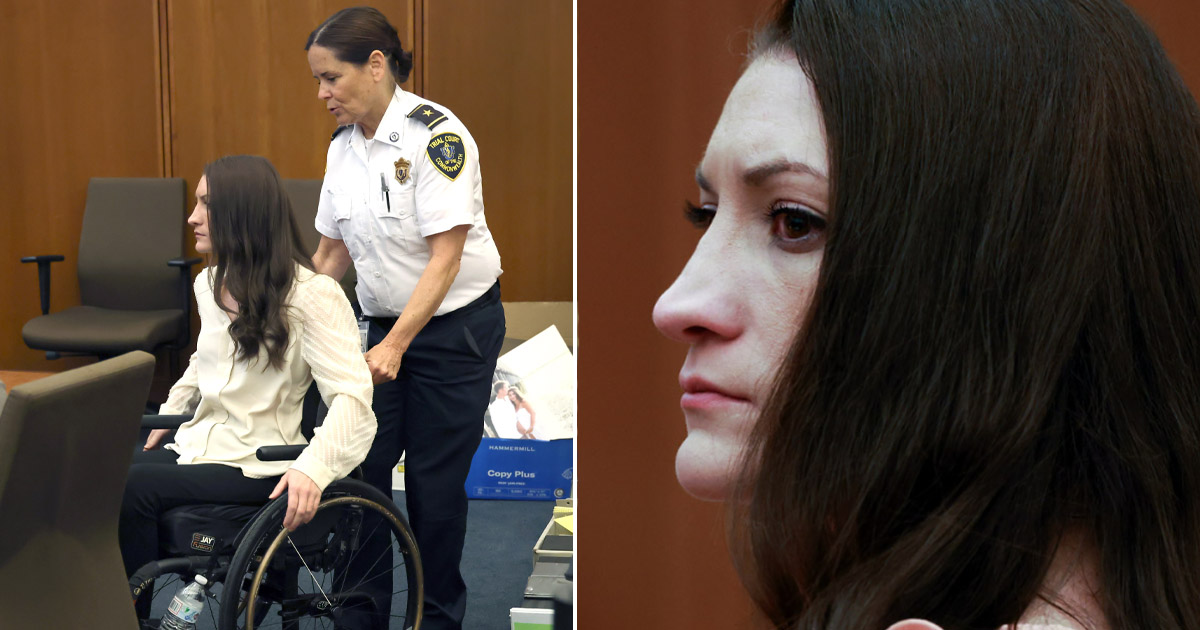
The Lindsay Clancy case ended without a verdict last week, and now the attorney for the Massachusetts mother accused of killing her three young children believes she could walk free after her trial ended in a mistrial.
Clancy is accused of killing her three children: 5-year-old Cora, 3-year-old Dawson and eight-month-old Callan, inside the family’s home in Duxbury, a Boston suburb, on January 24, 2023.
Her defense has maintained that she was not criminally responsible for the killings because she was suffering from severe postpartum psychosis and other mental-health problems at the time, while prosecutors argued that she understood what she was doing.
The jury was ultimately deadlocked at 11-1 after more than 38 hours of deliberations, leaving the case unresolved.
Her attorney, Kevin Reddington, told Judge William Sullivan that he plans to invoke Rule 25(b)(2), according to UNILAD.
Marian Braccia, a former assistant district attorney in Philadelphia, told People: “A Rule 25 motion is essentially a ‘sufficiency of the evidence’ mechanism. It allows the trial judge to enter a finding of not guilty if the judge concludes that the Commonwealth’s evidence was legally insufficient to sustain the conviction.
“In Massachusetts, the Rule 25 specifically contemplates a judge deciding a motion like this after a jury has been discharged without returning a verdict.
“So Massachusetts law specifically allows a judge to consider the sufficiency of evidence if the jury hasn’t been able to return a verdict and a mistrial has been granted because of a deadlock — which is exactly what happened in this case — and the judge declared a mistrial.”
A Rule 25 motion
Should the judge agree, Clancy would be declared not guilty.
Braccia explained: “If Judge Sullivan says, ‘I agree with the defense, the Commonwealth was deficient. They did not present sufficient evidence that any rational jury could find beyond a reasonable doubt that there was criminal responsibility here’ — then the result would be an acquittal.
“There would be an entry of a not guilty verdict. It would not be another mistrial, and that is enormously consequential, because an acquittal implicates double jeopardy.
“If she’s acquitted, that’s the end of this prosecution. If she’s acquitted, the Constitution says that she is protected from ever being prosecuted again for causing the death of her three children.”
What happens now?
Braccia also shared his own thoughts on the case.
“I think the Commonwealth has to be thinking right now about a few things. Whether it legally can retry the case, certainly — but whether it should retry the case in the same way, on the same charges, now that they’ve learned that 11 of the 12 jurors were reportedly favoring acquittal.
“Now, of course, the prosecutor’s mission is always to seek justice, and justice can mean a lot of different things. But they also have to be considering: Do we want to re-traumatize two grandmothers who lost three grandbabies?
“The expenses and the experts and the money spent on this seven-week jury endeavor, is that something the taxpayers want?”
With the jury unable to reach a unanimous verdict, prosecutors now have several options. They could bring the case back to trial with a new jury, pursue a plea agreement with Clancy’s attorneys, or decide to drop the charges altogether.
For now, however, Clancy remains under the same murder charges and continues to be held at the mental health facility as both sides consider what comes next. An update on the case will be provided by authorities on September 29.
Read more: