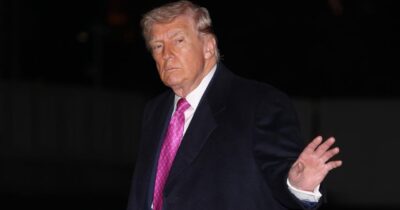
President Donald Trump has made it clear he won’t approve everything Democrats send him when the new Congress takes office in 2027.
Democrats have now won majorities in both the House of Representatives and the Senate in the midterm elections. The new Congress will be sworn in on January 3.
Speaking to Fox News after the Republican losses, Trump said a divided government has happened before. “It’s been done before, as you know, numerous times,” he said.
He pointed to the veto as one of a president’s stronger powers. “They’ll send over things that are insane and I’ll veto them,” he said.
Trump added that after a couple of months of vetoes, Democrats will ask how they can get things done, and “we’ll work together.”
He also appeared to send a message about his powers on Truth Social, where he shared a picture of a red cap with “VETO” across the front.
The veto talk isn’t new. Days before the election, Trump told the New York Post’s Pod Force One podcast that he would “become Mr. Veto” if Democrats won control of Congress, Bloomberg reported on November 1. Part of the interview aired on Fox News that day. Asked whether he could work with a Democratic majority, Trump said, “Well, if that happens, I guess I’ll become Mr. Veto.” Bloomberg described the comment as a rare acknowledgment from Trump that his party could lose.
What is a presidential veto?
Under Article I, Section 7 of the Constitution, the president can veto bills passed by Congress before they become law, as explained by Congress.gov. A bill becomes law if the president signs it, or if the president lets it become law without a signature after 10 days, not counting Sundays.
In a regular veto, the president formally rejects the bill and sends it back to Congress.
A pocket veto is different. It happens when the president receives a bill but can’t return it to Congress within the 10-day period because Congress has adjourned. The bill doesn’t become law, and pocket vetoes aren’t subject to the override process.
Can Congress override a veto?
After a regular veto, Congress can try to override it. That takes a two-thirds vote in both the House and the Senate for the bill to become law. Congress can’t override a pocket veto.
What can Democrats do without Trump’s sign-off?
The new Democratic-led Congress doesn’t need the president’s signature for everything. It can launch investigations into the administration, look into government spending and alleged misconduct, and issue subpoenas for documents and testimony.
One of Congress’s biggest powers is control over federal spending, which gives it a say in things like military funding. That could matter given the cost of the war with Iran. Reuters has reported that US costs have risen to more than $47 billion, according to a Pentagon estimate. That is about 25% higher than the Department of Defense’s initial estimate.
Share this with others who are keeping up with the current US political news and events.
Read more: