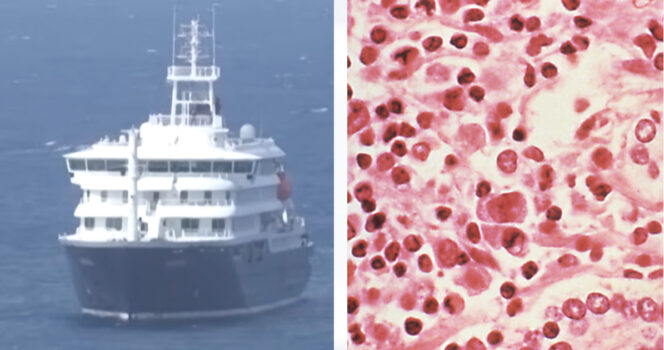
The hantavirus outbreak on the luxury cruise ship MV Hondius has taken three lives. So what really happened? Two terrifying possible causes have been identified, with an expert suggesting that passengers might be kept in quarantine for a long time.
A serious outbreak of a rare virus, hantavirus, has occurred on the cruise ship MV Hondius. So far, seven people have become sick, and three people have died. One more person is in intensive care, and others are still being checked by doctors. The BBC reports that the ship’s doctor has shown symptoms.
The ship was traveling across the Atlantic Ocean after leaving Argentina, visiting remote places such as Antarctica and small islands.
Health experts think the virus may have originated from contact with animals, especially rodents, during land travel. Hantavirus is usually spread through rat or mouse urine, droppings, or saliva.
However, no rodents have been found on the ship. Because of this, experts are also looking at whether the virus could have spread from person to person, which is rare but possible with a specific type called the Andes virus.
The first passenger became sick in early April and later died. More passengers began showing symptoms such as fever, stomach problems, and breathing issues. Some people were taken off the ship for treatment, while others stayed isolated in their cabins.
Hantavirus – terrifying possible causes
The ship is now waiting near Cape Verde while health teams investigate and try to stop the spread. Hantavirus is rare but can be very serious. It can cause severe lung problems and can be deadly in some cases.
Hantavirus usually spreads through contact with rodent waste, such as droppings. However, a rare type called the Andes virus can spread from one person to another. This type is very dangerous and kills about 40% of infected people.
The World Health Organization (WHO) said on Tuesday that this rare virus is likely the cause of the outbreak, which has killed three passengers and made at least seven others sick.
This idea became more likely after no signs of rodents were found on the Dutch ship, which left on March 20. The Andes virus is usually found only in parts of Chile and Argentina, not in the area of Argentina where the trip started.
Even so, health officials say the risk to the general public is very low because the virus does not usually spread easily from person to person.
Meanwhile, a health expert warned on Tuesday that the distraught passengers on board MV Hondius could face up to 2 months of quarantine.
“I’m sure people are isolated or quarantined in their rooms or cabins, but unfortunately, that quarantine period can take up to eight weeks,” New Jersey-based emergency medicine physician Sampson Davis told the NY Post. “The virus usually has a quick onset, but it can linger up to about eight weeks before it has an impact.”
“Some sort of commonality” between passengers, expert says
He added that since they have no clear rodent source, investigators must investigate and determine what links the infected passengers.
“There has to be some sort of commonality that took place with these individuals,” he said, adding that the hantavirus rapidly affects the heart and lungs, which can cause a fatal type of pneumonia.
So what is next for the passengers? Sampson Davis said the goal should be to get them off the ship as quickly as possible and into a land-based quarantine facility.
READ MORE
- Cruise passenger provides tragic update from ship after 3 people die in Hantavirus outbreak
- Five changes you’ll notice in your body after 30 days of taking Omega-3 fish oil