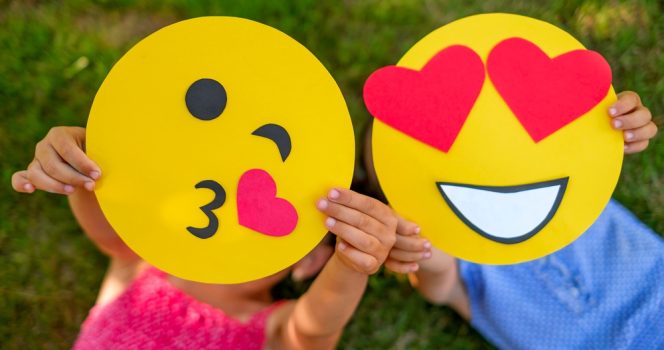
Emojis are the new digital mask for kids – plastered over tiny faces by parents who are hoping to protect their children from online dangers. But behind that smiley face or heart, AI is quietly working in the background, analyzing the image to identify the child who’s hiding behind the cartoon mask.
For some, parenting today means documenting every milestone – first steps, birthdays, family vacations – and sharing them with friends and followers. Others choose complete online anonymity for their children.
Then there’s a rising group of parents who straddle the line, opting to share photos but mask their kids’ faces using emojis – hearts, baby faces, or even playful devils. This hybrid approach, often adopted by celebrities, appears to strike a balance between sharing and protecting.
“Our kids are young. They’re amazing. But all you want to do as parents is protect them,” Meghan Markle told CBS in 2024 of protecting her children – Archie, 6, and Lilibet, 4 – from online harm.
“And so, as we can see what’s happening in the online space, we know that there’s a lot of work to be done there,” she added.
Even Mark Zuckerberg, CEO of Meta – the company behind Facebook and Instagram – has taken to using happy face emojis to cover his daughters’ faces in public posts. A striking paradox, considering his role in building platforms that thrive on personal data sharing.
Real danger isn’t what’s hidden
However, what started as a privacy-conscious decision among celebrities has now become normalized among everyday families. The emojis may differ, but the intention remains the same: show the world you’re proud of your children, while still protecting them.
But according to cyber security experts, the real danger isn’t what’s hidden – but what remains in plain sight.
Emojis do not offer privacy
Lisa Ventura, an award-winning cybersecurity specialist and founder of Cyber Security Unity, raised serious concerns in her interview with The Independent.
“I need to be brutally honest here: putting an emoji over a child’s face provides virtually no real privacy protection whatsoever,” Ventura told the outlet. “This approach is more security theatre than actual security.”
What this means is that slapping an emoji over your kid’s face feels more like a way to ease your own anxiety about privacy than a solid step toward actually protecting them.
Sharing identifiable information
According to Ventura, it’s not just the face that reveals identity.
“Even with the face obscured, you’re still sharing massive amounts of identifiable information” about your child, she warns.
Everything from school uniforms to location data embedded in the photo can expose children to risks. Even without the face on show, it’s still possible to glean details such as their “approximate age, build [and] location data from the photo,” Ventura adds – and “it all builds a profile.”
Facial recognition threats
The comfort that emoji-masking provides can lead to more frequent sharing, which only compounds privacy risks.
“Most parents aren’t just posting one carefully emoji-protected photo,” Ventura explains. “They’re sharing multiple images over time, and the combined data from all those posts creates a much bigger privacy concern than any single image.”
Each image builds a digital breadcrumb trail, and “every photo you upload trains facial recognition algorithms and builds advertising profiles,” Ventura shared.
Feels protective – but isn’t
Ventura acknowledges that emoji-masking is driven by a familiar impulse: the desire to share glimpses of family life with followers while still trying to hold on to some sense of control over privacy.
“Sharing joy is such a natural human instinct,” she says. “[Parents] want to share those precious moments, the first steps, birthday parties, family holidays.”
It “feels like a compromise because it allows parents to maintain that social connection,” while also “giving them the psychological comfort that they’re taking some sort of protective measure”.
“It allows parents to maintain that social connection,” Ventura says, while “giving them the psychological comfort that they’re taking some sort of protective measure.”
Pics used in unintended ways
Still, she likens it to a Band-Aid solution: “It might make you feel like you’re doing something, but it’s not actually addressing the underlying issue.”
“If you wouldn’t hand a physical copy of that photo to a complete stranger in the street, don’t post it online,” Ventura warns. “Because that’s essentially what you’re doing, except that stranger might be able to keep it forever, or worse, use it in unauthorized ways you did not intend.”
If protecting your child is the goal, then the safest route is still the oldest one: don’t post the photo at all.
Please let us know what you think of this story and share it with your friends so they will also be aware of the risks involved with using emojis to hide a child’s face in online images!
READ MORE
- Mom anonymously harassed teen daughter online for a year – now her horrific messages are revealed
- 14-year-old boy died after being “sextorted” by ‘girl’ online