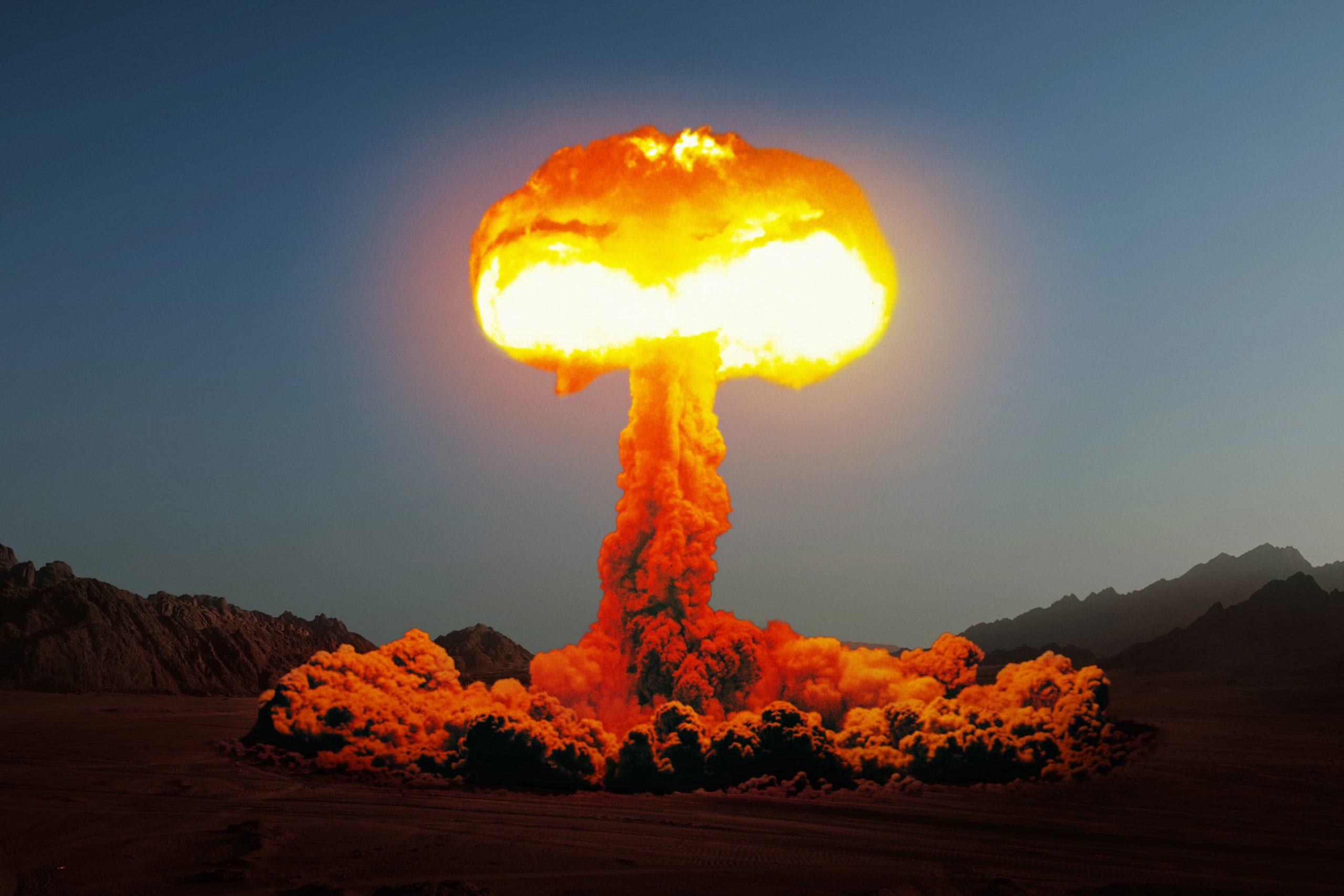
A Nobel Prize-winning physicist shared a chilling prediction that suggests we “have about 35 years” before a global catastrophe wipes out humanity.
David Gross, who shared the 2004 Nobel Prize in Physics, said he believes that rising global tensions and rapid technological development are creating conditions that could dramatically impact humanity’s future within just a few decades.
His comments arrive at a time when conflicts continue across several regions and concerns about nuclear weapons and emerging technology remain part of international debate.
Nuclear war threat
In an interview with Live Science, the Nobel laureate pointed to long-standing concerns about nuclear conflict, explaining that even after the Cold War ended, the threat never fully disappeared.
“Even after the Cold War ended, when we had strategic arms control treaties, all of which have disappeared, there were estimates that there was a 1% chance of nuclear war every year,” he said, adding that the likelihood may now be even higher as geopolitical tensions continue to shift.
“I feel it’s not a rigorous estimate that the chances are more likely 2%. So that’s a 1 in 50 chance every year.”
‘You have about 35 years’
Gross emphasized how quickly long-term risk grows when annual probabilities accumulate.
“Currently, I spend part of my time trying to tell people…that the chances of you living 50 [more] years are very small. Due to the danger of nuclear war, you have about 35 years,” said Gross, who won the 2004 Nobel prize in physics for developing the theory of asymptotic freedom.
That projection will place a possible tipping point around the year 2061 if current conditions remain unchanged.
He also pointed to growing instability across the global landscape.
“Things have gotten so much worse in the last 30 years, as you can see every time you read the newspaper,” he said. “In the last 10 years, there are no treaties anymore. We’re entering an incredible arms race. We have three super nuclear powers. People are talking about using nuclear weapons; there’s a major war going on in the middle of Europe; we’re bombing Iran; India and Pakistan almost went to war.”
AI and nuclear missiles
Alongside nuclear concerns, Gross highlighted the growing role artificial intelligence (AI) could play in global security decisions, particularly as automation continues to evolve.
“The agreements, the norms between countries, are all falling apart,” he said. “Weapons are getting crazier. Automation, and perhaps even AI, will be in control of those instruments pretty soon.”
He warned that the speed of automated decision-making may make it increasingly difficult for humans to intervene in critical moments.
“It’s going to be very hard to resist making AI make decisions because it acts so fast. If you have 20 minutes to decide whether to send a few hundred nuclear armed missiles to both China and Russia for ‘our dear president,’ the military might feel that it’s wiser to make AI make that decision,” Gross explained, adding that “if you play with AI, you know that it sometimes hallucinates.”
These concerns come as the Doomsday Clock ticks closer to midnight – or the global tipping point.
Doomsday Clock ticking toward apocalypse
In 1947 – two years after “Albert Einstein, J. Robert Oppenheimer, and University of Chicago scientists helped develop the first atomic weapons in the Manhattan Project” – the Doomsday Clock was created by the Bulletin of the Atomic Scientists.
The clock, a “universally recognized indicator of the world’s vulnerability to global catastrophe caused by man-made technologies,” was initially set at seven minutes to midnight – the time symbolizing an “apocalypse.”
Each year, a team of scientists, including eight Nobel laureates, evaluate global threats – like nuclear weapons, climate change, and technological risks – and adjust the clock to reflect the level of danger facing the world, pushing the hands closer toward the end point.
For 2026, the clock was set at just 85 seconds to midnight – “the closest it has ever been to catastrophe,” according to the Bulletin.
“A year ago, we warned that the world was perilously close to global disaster and that any delay in reversing course increased the probability of catastrophe,” the Science and Security Board with the Bulletin explained of its update this year. “Rather than heed this warning, Russia, China, the United States, and other major countries have instead become increasingly aggressive, adversarial, and nationalistic.
“Far too many leaders have grown complacent and indifferent, in many cases adopting rhetoric and policies that accelerate rather than mitigate these existential risks.”
‘We can also change course’
Melissa Parke, Executive Director of ICAN (the International Campaign to Abolish Nuclear Weapons), explained that the clock is intended to raise awareness rather than provide an exact prediction.
“The Doomsday Clock is not a prediction, it’s a warning,” Parke told The Standard. “Nuclear weapons, wars from Ukraine to Gaza, the climate crisis and runaway technologies are all part of the problem – but they are all created by humanity.”
“That means we can also change course. The Treaty on the Prohibition of Nuclear Weapons (TPNW) is a clear path to turn back the hands of the clock,” she added.
What do you think about this chilling prediction – should we be concerned about where the world is heading, or are warnings like this meant to spark necessary change? Please let us know your thoughts and then share this story so we can get the conversation going!
READ MORE
- The first things that will happen to Melania if Donald Trump dies in office
- Film star dies after being found unconscious in swimming pool